
Good lawyers and competitive retaliation will only take you so far.
As the Howden team lifts this past year have shown, it is difficult for even the most established brokerages to defend against a sudden mass loss of staff to a competitor.
The team lift game is structurally tilted towards the attacker, as we argued in the first part of this two-part series. They have an integrated toolkit they can deploy to carry through a lift-out, and they determine the target and timing.
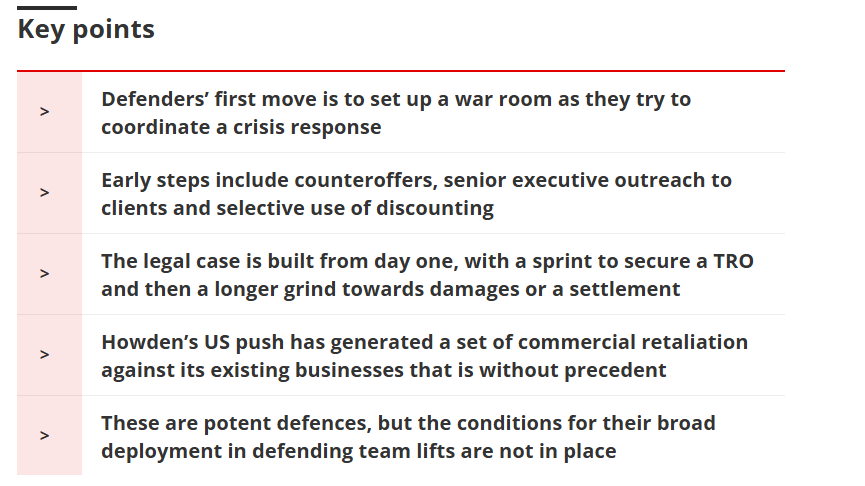
The defenders are not defenseless, however. The besieged brokers have developed a playbook around talent retention, crisis management, aggressive litigation and, most recently, commercial retaliation against their attacker.
This playbook can slow the bleeding, but to date does not appear to be sufficient to deter attackers or to undermine the economics of the team lifts.
Cleaning up after a competitor poaches staff is never going to make a firm fully whole. Court awarded damages can’t reinstate major clients, undo reputational damage or replace lost human capital.
The best a defender can hope for is to limit the damage, chip away at the economics for the attacker and encourage attackers to look to other targets next time.
The firms that are industrialising team lifts do not seem to be discouraged by the standard defence playbook, with the boost to the organic growth line judged to be worth the turbulence and downside risk.
Howden’s recent raids have sparked a new form of counterattack. Alongside the traditional legal fight, Howden’s rivals have mounted a campaign of fierce commercial retaliation, striking at its London wholesale arm, its MGA business Dual and Howden Re.
This piece will explore whether this nuclear option could rebalance the tilted field of play.
First line of defence: Prevention
The best way to avoid the poaching scenario is prevention. Broking executives need to build businesses that brokers do not want to leave.
A major part of that calculus is competitive compensation. If pay is already high, would-be poachers will struggle in the sort of mass poaching scenario that played out in brokerage offices this past year, where some employees reportedly received offers from Howden after minimal interviewing and vetting.
Often a competitive pay structure involves offering equity as well, which provides employees with a strong incentive to stay in a role since leaving would mean giving up that valuable compensation.
Alongside compensation, brokerages that are perceived as winning teams with strong, producer-friendly cultures and low bureaucracy are more difficult to raid.
However well this is done, the first line of defence will always be vulnerable if the attacker is offering staff the 20%-60% salary bumps and equity packages Howden has been offering.
When the walls are breached: Crisis response
Firms that have been targeted will need to quickly shift gears once they receive resignations.
There is a narrow window to turn defectors after they have resigned, or as they weigh an offer before joining colleagues in quitting.
Guy Carpenter offered to match offers for a number of targeted staff when Willis Re went on a poaching spree of roughly two dozen employees in 2025, helping it to retain a good chunk of those originally in-scope for the lift, it is understood.
Senior executive intervention is another level, though its track record is mixed. It is understood that Marsh Risk CEO Martin South flew to Florida to try to retain Mike Parrish when he resigned last summer to go to Howden US, where he is now CEO.
Brown & Brown is understood to have offered discussions directly with CEO Powell Brown or retail president Steve Hearn to defecting employees in a bid to get them back on board. It is understood that three texts were sent to all defectors offering these conversations except for the two most senior leaders who departed.
Sources have said that Marsh managed to get at least some employees to rescind their resignations during the Howden US raids.
Last year, two senior aviation brokers walked back their resignations from Guy Carpenter after their employer successfully countered the offers they had accepted at start-up rival Willis Re.
Alongside efforts to pick off some of the defectors, the defenders also set to work in parallel on retaining the at-risk clients.
This work starts with mapping client relationships to departing staff to identify points of vulnerability.
Next, the defenders deploy senior executives in outreach to clients and scramble to air lift resources in from other parts of the group to demonstrate servicing capabilities remain intact. In some cases, the defending broker will pre-emptively offer reduced fees or some kind of commission rebate to try and cement the relationship.
After the Willis Re team lift, a detachment of Guy Carpenter executives was dispatched to Munich to reassure Allianz, a key reinsurance client, about its ability to deliver, and to emphasise the importance of the whole group trading relationship.
Alongside these moves, defenders also look to control the narrative with wholesale broking partners and carriers. Sometimes they will play hardball with the latter and try to discourage them from trading with the raiding company.
Where counteroffers fail, besieged firms typically signal that non-compete and non-solicitation provisions will be enforced.
In the case of Brown & Brown, it is understood that senior staff were dispatched to all seven of its affected US offices at 06:30 on the day after mass resignations were announced to assess the damage, secure any evidence of wrongdoing and rally remaining staff.
Even though the defections occurred just before Christmas and a weekend, a war room was set up. Resignations were traced to determine the extent of the damage and to try and keep remaining staff. Top executives were made available to try to persuade people to un-resign or give details about the poaching effort.
“Didn’t take [t]hem long they are calling me from the highest levels let’s dig in,” wrote Eric Kasen, who left Brown & Brown to become a managing director at Howden, in messages disclosed in litigation between the two.
Kasen was encouraging defecting employees to get broker of record signatures to sign up Brown & Brown clients with Howden over the weekend and promised they would be “handsomely rewarded” for getting those signatures.
Building a case: Containment
As the internal crisis response unfolds to shore up the staff base and retain clients, firms are faced with the parallel priority of building a case for litigation.
From day one, even as efforts begin to turn staff back and stop client outflow, gathering as much evidence of potential wrongdoing is imperative.
As mentioned in Part I of this series, brokerage firms are heavily reliant on the connections and relationships of their staff to drive value, with things like intellectual property and physical assets less important than in other sectors.
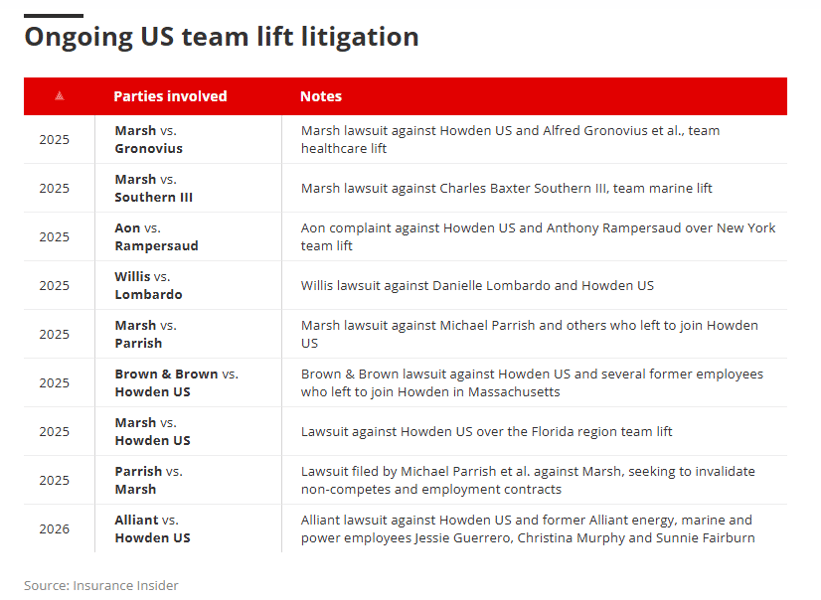
But that does not mean there are no assets to protect, as the numerous lawsuits against Howden illustrate.
Valued employees have access to sensitive pricing and renewals data and documents, which can be used against a firm as easily as they can be printed out and put in a backpack or sent in an email to a personal Gmail account.
Tracking down where that information was compromised is central to building a legal case against defectors.
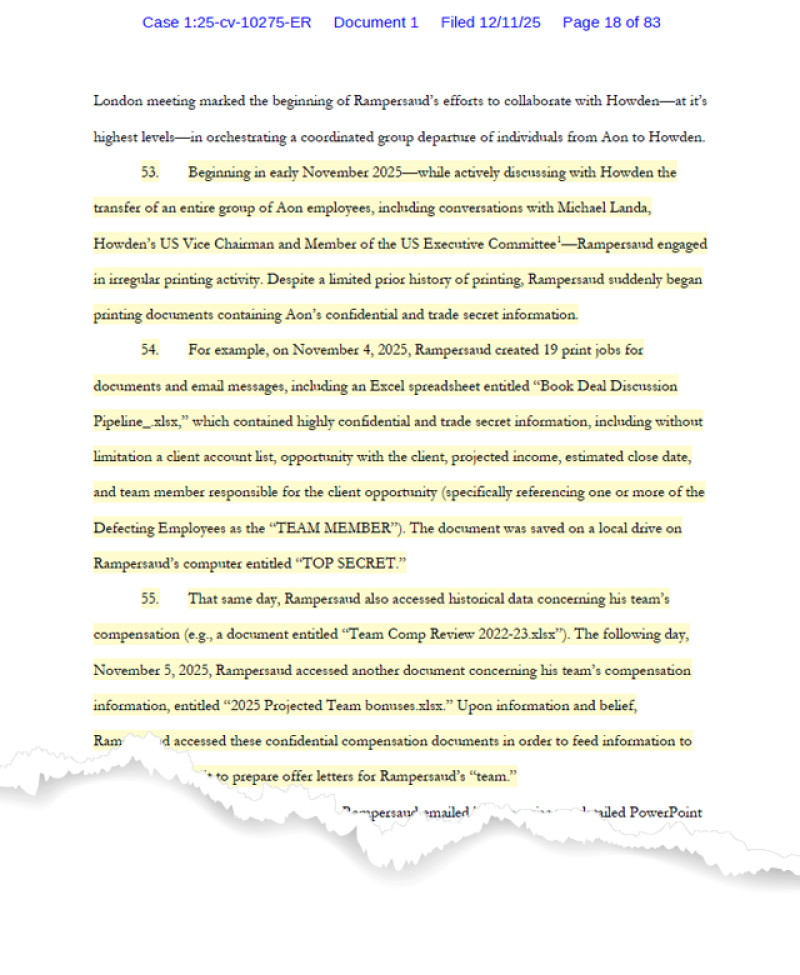
Former Aon employees who left for Howden last year allegedly tried to box up sensitive documents that they had labeled “TOP SECRET” and mail them via FedEx. Aon was able to stop the documents before they left the FedEx facility, since the documents were sent with a company account, according to a lawsuit the broker filed last year.
One company that had staff poached hired a private investigator to dig into the life of the team leader who left the firm, according to a source. An executive found out after the investigators were caught rifling through the team leader’s rubbish, it is understood.
But efforts by digital forensics experts can run into difficulties if departing employees use fairly simple tools to evade detection. Departing staff can use burner phones, as well as encrypted messaging services like WhatsApp or Signal, to ensure communications and work aren’t traceable.
Employees may also factory reset or even destroy devices in an effort to evade evidence capture, adding yet another layer of difficulty for firms defending themselves against a staff raid.
The legal battlefield
Lawsuits are a near-immediate concern after staff start to depart en masse and as executives try to stanch the bleeding of talent and clients.
The defenders work at breakneck speed, seeking intelligence on the raid and gathering IT forensics – with senior executives sometimes sleeping in their offices. External law firms are also pushed hard to file at the first moment possible with the goal of getting preliminary relief blocking the predatory firm from taking more staff or clients.
Plaintiffs can secure temporary restraining orders or preliminary injunctions quickly, sometimes within days, blocking former employees or poaching firms from soliciting clients or staff, and blocking the use of internal documents.
If presented with evidence that a poaching firm is likely to continue poaching clients or staff in potential violation of employment contracts or trade secrets protection law, courts can offer injunctive relief to stop further bleeding and clearly order the poaching company to honor employment contracts, leave clients alone and return any company property.
Howden was compelled to agree to a temporary restraining order roughly a week after its raid on Brown & Brown. But the prohibitions can take longer as well, as seen in Marsh's lawsuit against Parrish and Howden. Here, it took weeks before a judge granted the relief.
But that early relief presages a potentially costly process that may not result in major court-mandated damages. Hiring forensic experts and white glove law firms is expensive, and companies like Howden or Alliant that have industralised team lifts are hiring the same calibre of attorneys to fight these cases.
Getting an order from the courts blocking further damage to a firm clearly slows a poaching firm down or sets them up for possible contempt charges if they ignore the court’s directives.
Litigation serves four broad purposes. It disrupts further hiring and client solicitation via injunctions. It distracts the raiding firm's management from execution. It imposes financial penalties through awards, settlements and legal fees. And it damages the attacker's reputation by establishing unlawful conduct in a public forum.
These are real costs – but they do not seem to be enough to deter the attackers.
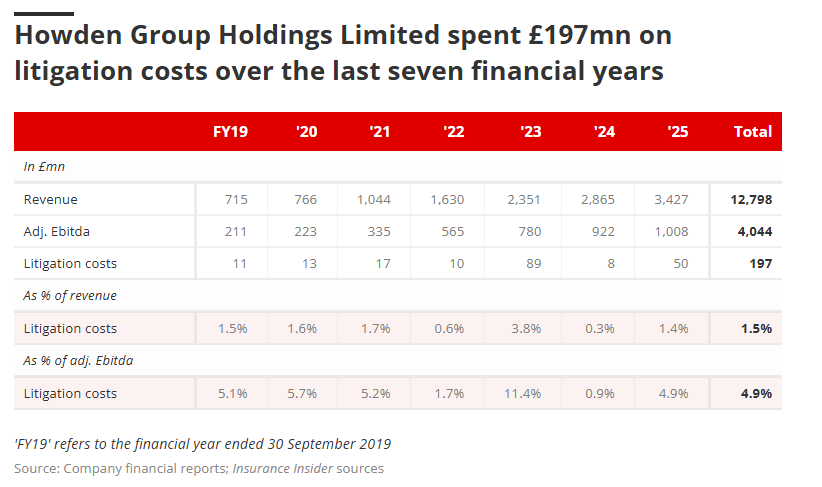
Howden reported spending £50mn in 2025, down from its 2023 peak of £89mn – but the expectation is that this will exceed £100mn in 2026.
Crucially, however, these costs – along with a number of other elements of the team lift bill – can be adjusted out of the Ebitda figures Howden uses when financing debt or equity. These investors are effectively looking through these costs as they would with M&A outlays.
Navigating the legal patchwork
In court, the specifics of contracts become important. There is no one-size-fits-all contract rule that determines the outcome of cases.
The US has multiple different legal systems working in parallel, including the federal system and a separate system of laws and procedures for each individual state and territory.
That means that the validity of employment contracts will depend on which jurisdiction a case is filed in, making it crucial for suing companies to choose the right forum where courts take an employer-friendly view of employment contracts.
For the most part, team lift lawsuits will be determined by state laws – and each state has a different approach to employment contracts. New York and Massachusetts have become particular focuses in the Howden litigation.
In Massachusetts, a state law explicitly says that employment contracts and non-competes are enforceable if they meet a set of rigidly defined criteria. Generally the employee needs to be given ample time to fully consider the contract, and the scope of the restrictions must be reasonable.
In New York State common law, under which many of the Howden US lawsuits are currently pending, non-competes are generally enforceable to protect trade secrets. But judges require them to be reasonable in scope, and there is a general momentum against enforceability except where employees are making $250,000 or more a year.
One lawyer said that a common defence for the hiring firm is to have incoming employees sign agreements stating that they are unaware of contracts that would block them from working at the new company.
Hiring firms also often instruct employees not to discuss their new roles in the old office with former colleagues and to contain their contacts about the move to official channels with their new firm’s team.
“If you’re bringing over a very, very large cohort, it’s really important to have the documentation in place showing that you’re taking steps to mitigate and show that you were taking all the steps you needed to make sure that everyone knew they needed to comply with their obligations before coming over to you,” a legal sources said.
Ending the fight before trial
Typically, defendants will seek to settle cases very soon after preliminary injunctions or temporary restraining orders are granted. In many of the Howden US cases, preliminary injunctions have been granted. But few cases have been settled as Marsh, Brown & Brown and others hunker down for a potential long-term fight.
Here the defenders are weighing the upside from a certain cash payment against the risk, cost and distraction of pursuing a case to its conclusion.
After preliminary injunctions or temporary restraining orders are issued, sources said that settlement discussions are often favoured because the case moves into a much more precarious phase.
Judges can also encourage parties to engage in settlement talks to deter a prolonged fight in the courts that ties up resources.
The next step, discovery, is particularly risky for both sides. Depositions are unpredictable, and it is impossible to know with certainty what might be uncovered when private texts and communications are found.
And lawsuits beget media coverage and headlines, which means unsavoury details spreading through the market that can harm reputations.
“You don’t know what people are going to say, when asked in deposition, ‘Ok you sent these documents saying you’re not going to breach their agreements. But how did you think the leader of the group was going to miraculously get 500 people to sign up within two days?’” a lawyer said.
None of that appears to deter the likes of Howden and Alliant, which have elevated the use of team lifts as a growth strategy in recent years. There is relatively little evidence that clients refuse to work with them because of the strategy, and uncomfortable headlines have done little to change behaviour.
The nuclear option: Commercial retaliation
Brokers targeted by the Howden raids last year have been turning towards commercial retaliation, marking a potentially potent new tool for firms to push back beyond the traditional means outlined above.
Howden has faced three different forms of commercial retaliation to its hiring blitz in the US.
First, US retailers including Alliant, Marsh and Brown & Brown are redirecting London wholesale business away from Howden to competitors. Sources estimate that $1.5bn-$2bn of premiums are being moved to other brokers.

Second, US retailers are choking off business from Howden’s MGA arm Dual. This contributed towards an 11% shrinkage in organic revenues at the $3.4bn-premium MGA in the three months to 30 September.
Third, US retailers that own MGAs are likely to swap out Howden Re as their capacity broker. Brown & Brown has already placed the $15mn Arrowhead deal under review, and it has other MGA business where Howden arranges the capacity.
We are yet to see how these counterattacks play out, but given that they strike profitable incumbent businesses and create organic growth headwinds, they are likely to prove more potent.
There will be limits to how widely applicable this nuclear option is, however. Howden has found itself exposed to these attacks because it is a diversified brokerage with a range of businesses where retail rivals have leverage.
A domestic US retail broker without reinsurance broking or MGA operations would not be open to similar punitive measures.
The tilted playing field
The defender’s playbook is broad-based, and the weapons at its disposal are not trivial.
A small number of staff can typically be turned through counteroffers. The war room outreach from senior executives and discounts shore up some clients that could otherwise jump. Temporary restraining orders buy time to rebuild. And litigation imposes costs on the attackers – financially and in terms of time and reputation.
Commercial retaliation offers a new front in the fight that is just being developed, but which is probably not going to have very broad application.
As such, the playing field still looks tilted towards the attacker. Particularly given the soft market backdrop, team lifts are likely to remain a defining feature of the competitive landscape.
The stakes will only rise in an environment where organic growth is increasingly hard to come by, and more brokers reach for the attacker’s playbook.