
Industrial-scale team lifts are raising the stakes for all brokers.
Team lifts and the disputes around them have become one of the most fiercely contested battlegrounds in insurance broking.
Broking is a war for growth, with incumbents fighting to maintain the top spot and challengers vying for position. In that war, moving teams with meaningful control over revenue is a shortcut to growth.
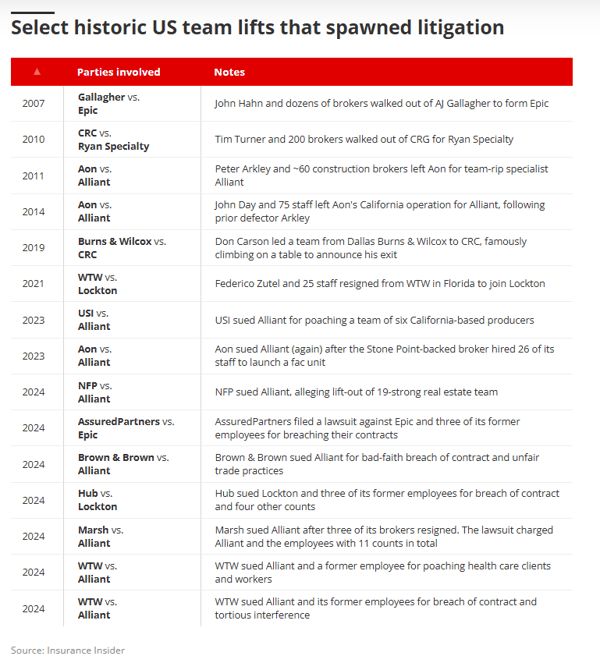
In the past ~15 years, team lifts have become a key lever of growth for many brokers alongside M&A, and for a couple of the most prolific firms, the most important lever.
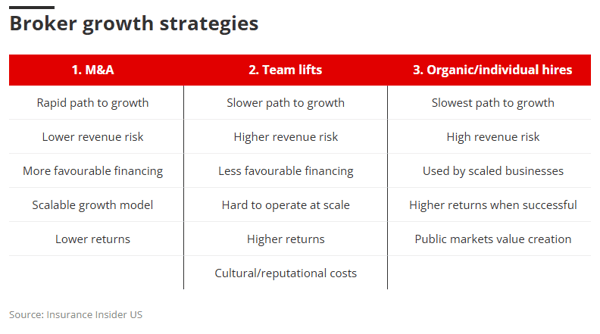
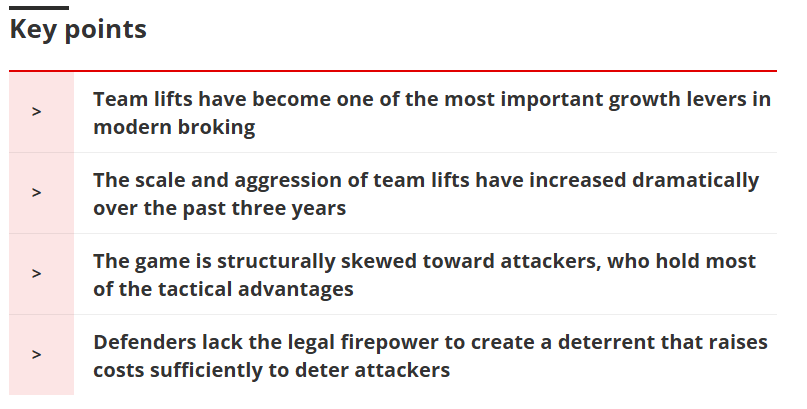
In the past three years, the scale and aggression with which the practice has been deployed has changed the game – with the attackers’ playbook increasingly well honed.
The upscaling of team lifts as a strategy is seen most clearly in the multiple, hundred-strong raids carried out by Howden, but it is not the only broker that has put team lifts front and centre.
Crucially, this upscaling has raised the stakes for all brokers. What would once have been dismissed as sharp practice is now, in some quarters, simply competitive strategy – and the previous consensus around the ethics of team lifts has fractured along the fault line between attackers and defenders.
That means that all brokers must think hard about whether they accelerate growth through team lifts and how to buttress their town talent bases from attack.
It is important to note here that this game is not played on an entirely level field – at least to date, there has been a clear asymmetry. Although the largest brokers are deploying vast resources to fend off attack, they are at a structural disadvantage.
They never know when a competitor might strike or where in their organisations that strike will hit – and the legal recourse available to them lacks the sting that would create an effective deterrent.
For the challenger brokers, there is so much upside in buying growth they can run through the organic growth line. For them, everything is to play for.
Right now, the game is defined by the professionalisation of the offense’s toolkit and the ineffectiveness of deterrents. Defenders are starting to test new ground with massive commercial retaliation of the kind Howden is currently subject to as they try to rebalance the playing field, as we will explore in part II.
The zero-sum game
Growth is the key value driver for brokers, and in a market downturn like the current soft cycle, they must work much harder to deliver it.
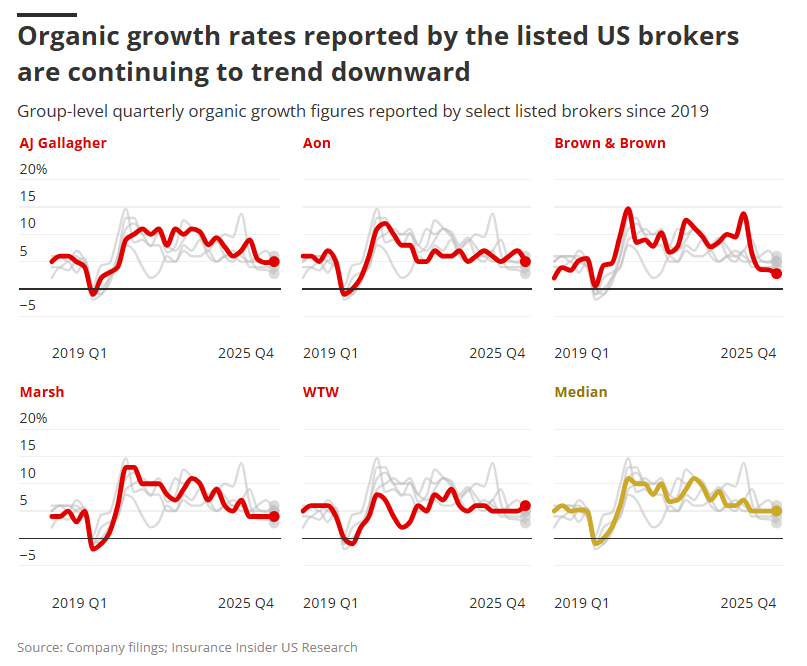
For brokers, one source of growth is expansion into new products, clients and regions or upselling to existing clients. Breaking new ground, however, can be a painful and slow process.
Prying talent and clients away from competitors en masse can be faster, though it too involves upfront cash-burn and greater downside risk.
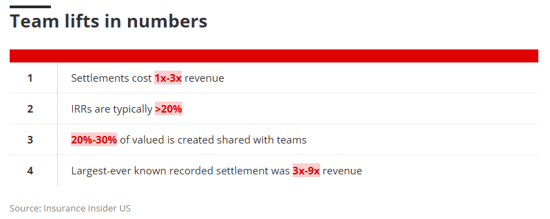
The thesis behind team lifts is that the acquiring business can pick up revenue at a lower Ebitda multiple through bringing in a team than through a company acquisition, while juicing their organic growth.
In short, the combined costs of sign-on bonuses, professional services fees, settlement costs and accumulated losses during the ramp-up fall significantly short of the 13x-18x multiple that might be paid to acquire a business.
There is also scope to be more surgical in acquisitions, filling in specific gaps in product sets and regional capabilities rather than having to buy businesses that will bring messy overlaps.
Team lifts are a cheat-code on growth.
That incentive has created a war for talent that is essentially a zero-sum game, with competing firms fighting over a limited pool of people – and the strategy employed in that game is highly dependent on the player.
For the largest and most mature incumbents, the game is all defence, as they try to fend off challengers seeking to leach away their strength.
For challengers, the play is skewed far more towards offence as they seek shortcuts to accelerated growth.
Some brokers with high degrees of leverage also have an especially acute need to grow fast, as they work to service their debts and ultimately double or triple their PE backers’ investments.
Attackers have developed a selection of tools to pull teams out of competitors that work together to blindside the target company and neuter attempts to retain staff.
That toolkit, explored in more detail below, brings together opportunity mapping, the use of key staff as recruiting sergeants for both colleagues and clients, rapid job offers, secretive communications, legal indemnification for defecting staff and highly compelling remuneration deals.
The drawing board: Identifying targets
The first stage of the play, once a firm has opted for a team lift, is the identification of potential targets.
Businesses looking to acquire a new team in a certain line or region can map out top talent – and whether they would be open to an offer – through discrete conversations with trading partners, typically the (re)insurers.
Another source said one strategy is to screen for teams that perform well but are undervalued because they are sub-scale within their current organisations. These are easier to pry out of a company and less likely to provoke litigation, sources said.
Many firms use recruitment consultants to conduct research exercises for them. Some consultants are proactive, approaching a business with a likely prospect for hire first.
One source described the process as “orchestrating chance” – mentioning to an executive at a hiring firm that a certain individual might be looking to move and testing out their appetite to hire any members of that individual’s team who may follow.
Companies looking to hire also face a decision about the scope of the team lift on the table – whether to attempt to take out all or most of a rival’s functionality in a given line of business or region, or just a few select names.
The most aggressive lifts, targeting an entire unit, are driven by the hiring company’s desire for a “game-changer” team acquisition and will only be possible where there is widespread dissatisfaction in the target team. These carry greater legal risk.
The rulebook: Clean versus dirty
Not all team lifts are executed in the same way. We draw a distinction between a “clean” and a “dirty” team lift.
A clean lift is one in which the hiring employer does everything possible to avoid unlawful behaviour on its own part and seeks to keep its new hires operating within the rules.
In a dirty lift, the hiring firm privileges the speed of execution and size of the win over respect of the rules.
The dirty lift has become more prevalent over time, with the adjusting out of legal costs from earnings meaning that hiring firms can win via hiring, even when they lose in court.
The clean getaway
There is a generally accepted playbook for a clean lift.
Sources stressed the importance of avoiding collusion with a leader at a target firm to recruit their team. This could include acquiring information that would help to hire staff, such as salaries, from that principal.
This was the case in Willis Re’s team lift from Guy Carpenter (GC) last year, in which former GC Bermuda CEO John Fletcher provided Willis president of risk and broking Lucy Clarke with pay information about his GC team.
In many cases, sources said, using a recruitment consultant as a “fire break” is key, as they do not have the same duty to protect the target business from attack as the team leader at that firm.
Recruiting into existing positions is also a way of avoiding legal repercussions, sources said. If a company is advertising for a set of jobs to launch a new team, it is conceivable that staff at a rival firm applied for them proactively.
Where multiple staff are hired from a rival firm into unadvertised roles and without formal interviews, accusations of collusion and poaching are far more credible.
Some sources said firms looking to recruit teams also steer clear of informing team members of the key leadership hire.
Firms make offers to individuals – crucially, one by one, with no information on colleagues who might also be leaving – outlining the launch of a new unit at a firm, headed by a “well-known, senior figure” in the sector, whose name they will not be told unless they accept the offer.
Staff targeted in a team raid must also avoid any traceable discussion with each other about the opportunity in order to pass as fully clean.
Finally, targeted staff must not attempt to take with them any proprietary information on clients or policies.
Taken collectively, this is a high bar – and firms that aim to go clean sometimes fail in the execution and go dirty.
A clean lift only stays clean if everyone involved adheres to the principles. As a large lift involves dealing with people “up and down the food chain” across the hiring firm’s senior management, operational staff, HR function and new recruits, that discipline can be difficult to maintain.
One source recalled undertaking a lift involving a small number of staff – but with an outsized, profitable book of business.
The operation, which had so far been executed cleanly, was almost scuppered by an email from the HR division of the hiring company entitled “Team Lift”.
Another source invoked the British Army adage that “proper planning prevents piss poor performance”.
Companies fail to keep a lift clean “when things are not thought through, or the people involved are not aligned on what they need to do”, the source said.
“You need everyone to understand the risks involved.”
In the past, companies have used the risk of legal repercussions to inspire that discipline in the staff they were recruiting.
A source described JLT’s approach during its attempt at a US retail play in the 2010s. In that case, JLT refused to indemnify recruits if they breached their covenants and were sued by their former employer – essentially, using a stick rather than a carrot when it came to legal risk on individuals.
Now, however, it is far more common for recruiting employers to take the legal liability off their would-be recruits' shoulders, supplying paid-for lawyers to guide them through the process.
Hiring companies also commonly offer a much greater incentive to defectors today than historically. Whereas in the past, hiring companies relied on recruits’ belief in the business as an incentive, it is now common to offer incoming staff a combination of salary increases running 20%-60%, sign-on bonuses and guaranteed bonuses for three to five years, alongside large but uncertain equity deals.
The dirty playbook
When a firm decides to go dirty, speed becomes the governing principle and the evidence trail is the cost of doing business.
Hiring companies and their new recruits must not only avoid accusations of collusion (even where collusion has been employed) but also deny the target company time to cauterise the wound after a raid.
This gives rise to some of the more dramatic elements that arise during trials.
In the legal action concerning Dual’s 2025 recruitment of 22 transactional liability staff from Acquinex, for instance, damaging text messages came to light.
Former Acquinex southern European head Jaume Benajiba’s text messages were used in legal proceedings.
In one, he said to other defecting colleagues: “Morning lads. Dresscode [sic] to meet God?”
“God” in this instance was interpreted by Acquinex’s lawyers as Howden CEO David Howden, and the message held up as evidence of a group meeting among staff with Howden to discuss defection.
In some instances, the defendants have been caught approaching clients directly soon after they move to another brokerage.
In one lawsuit in California, NFP provided evidence that one of its former executives moving to rival broker Alliant had approached different clients noting that most of his team had left the Aon-owned retailer.
“Wanted to let you know that a majority of my team has left NFP for Alliant. Not sure if this has been communicated to your team yet. Would like to stay in touch if things don’t work out [with] NFP. Happy to jump on a call or meet in person,” a text to a client read, according to the complaint.
“Let me know if you two have any time to connect in the next week or two to discuss. Obviously, we’d love to continue the relatiohship [sic],” an email from the same team leader to a different client read in the lawsuit.
In a bid to avoid moments of indiscretion coming to light in court, some companies provide incoming teams with “burner” phones to prevent them communicating via discoverable media with either the hiring company or each other.
It has also become common practice for defecting staff to communicate via WhatsApp with the “disappearing messages” setting activated, to delete messages manually or to perform factory resets on their phones before legal discovery.
In the GC-Willis Re trial last year, multiple incidents of phone-resetting emerged in evidence. Former GC marine and energy broker Graham Devlin, for instance, carried out a factory reset on his phone during his exit interview.

Several cases include scenarios where an exiting broker has printed off client information, sent it to their personal email account, or downloaded it onto a portable device, in the mistaken belief that it cannot be traced.
During Lockton’s lawsuit against Alliant in 2019, concerning the defection of multiple staff from Lockton’s Mountain West companies, Lockton alleged that immediately before resigning, a group of defecting staff printed “numerous documents containing confidential information, including customer financials and prospects, customer contracts and email communications with customers”.
In other cases, there have been examples of defendants destroying devices in a bid to cover up an attempt to take proprietary information with them to their new employer.
In 2010, Marsh sued Aon over the defection of senior broker Euan Nicolson, alleging that he worked with Aon on a successful tender for the Italian gas and oil company Saipem’s business while still in Marsh’s employ.
In that trial, the judge ruled that Nichlson had committed “very serious contempt of court” through disposing of devices, including throwing a laptop in a pond and three USB sticks in a river.
Another example is found in Aon’s suing of Howden over the latter’s 2021 hiring of the former’s private finance initiative team, led by Paul Tubb.
The claimant said in its evidence that Tubb’s company laptop, mobile phone and sim card were found to have water damage when he returned them. Tubb claimed he had dropped his laptop in the bath and fallen into a swimming pool with his work phone in this pocket.
Other cases reveal instances in which hiring companies and defectors have managed to keep the details of their plans close – only to momentarily let slip to the wrong people incriminating details.
In 2019, Marsh sued Cobbs Allen Capital over its recruitment of Mike Rice, previously US chair at Marsh’s then-new subsidiary JLT, for its division CAC Specialty.
Rice left JLT in April 2019. But CAC chairman Paul Sparks accidentally revealed to Patrick Donnelly, then US head of Marsh JLT Specialty, that his plans to hire Rice for a specialty division were longstanding.
In its evidence, Marsh claimed Sparks ran into Donnelly at the Council of Insurance Agents and Brokers conference in Colorado Springs in October 2019.
The pair discussed a mutual acquaintance who also knew Rice. Sparks mentioned the acquaintance’s surprise when Sparks told him of the venture with Rice.
When Donnelly asked Sparks when that conversation took place, Sparks answered, “May”.
The filing then detailed: “Upon giving his answer, Mr Sparks went pale, bent over at the waist, said, ‘Oh shit’, and asked, ‘am I on the record?’”
Brokers undertaking a team move also need to move quickly in order to execute successfully.
That need to move fast with job offers was exemplified in the GC-Willis Re court case last year around Willis Re’s hiring from GC’s Bermuda and London offices.
Evidence included an email from Willis Re chief people officer André Clark to Neha Tandon, senior vice president of Willis Re investor Bain Capital.
The email was dated 6 June, days before a wave of GC staff resigned. Clark wrote of the need to complete recruitment deals with further GC staff “before we get a bloody injunction!”
Locking down and lawyering up: The fightback
The Willis Re email is characteristic of the modern lift. The attacker chooses the timing, controls the information and has already absorbed the legal cost into its financial model before the lawsuit is filed.
We will explore in Part II whether defenders have managed to develop an adequate answer to that asymmetry.