


Analysis summary
What should the ILS market be watching after Monte Carlo? Three trends stand out heading into 2027: cat bond managers are still compounding growth, capital is starting to pivot towards private ILS, and long-tail interest is running well ahead of the deals available. This analysis shows how UCITS cat bond assets have grown around 24% in twelve months to $21.1bn while pricing multiples have compressed to their lowest since 2018, why some managers have temporarily stopped inflows, and what is drawing investors towards casualty sidecars. It delivers fast insight on how cat bond spreads now compare with high-yield corporate debt, where the fee advantage sits for ILS firms, and the liquidity and alignment challenges emerging in long-tail structures.Subscribe to get comprehensive access to our exclusive analysis in the full platform.
Cat bond firms are still amassing growth, but concerns around oversupply leading to soft-closes.
Reinsurance conference season marks the start of a globe-trotting phase for ILS firms sweeping up funding commitments for the year ahead, with an increasingly nuanced-looking outlook for 2027.
Several key trends are evident that will impact the shape of the ILS market's competition in 2027, as sister title Insurance Insider ILS has been covering recently.
Cat bond managers still amassing growth
First, cat bond momentum continues apace, with income growth compounding assets and $2.3bn in Q4 maturities set to return cash to ILS managers to reinvest.
The UCITS European fund structures are a significant and popular component of cat bond assets overall, and data from Plenum Investments shows that UCITS fund universe has gained around 24% in AuM in the past 12 months, reaching $21.1bn.
The Q4 cat bond pipeline of new deals is expected to be healthy as sponsors seek to take advantage of compressed rates.
Average pricing multiples fell to 1.8x in Q3 on light deal volume, according to Insurance Insider ILS data, the lowest since the second half of 2018.
However, given the low deal flow, Q2's 2.6x multiple of spreads relative to expected loss levels may be more meaningful. The Q2 figure was the lowest quarterly average since mid-2021, and it is down from 3.7x through the Q4 2024/Q1 2025 renewal season.
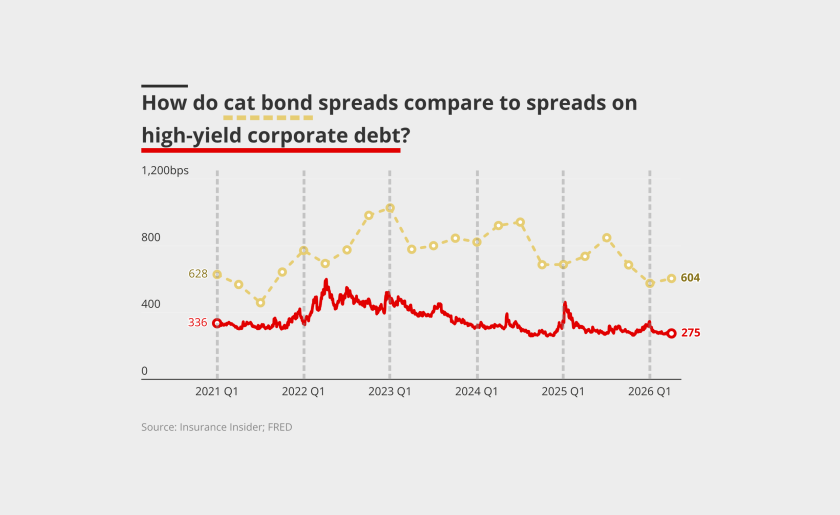
Part of the reason for ongoing investor interest in the sector, even as multiples weaken, is the relative value argument.
Even as spreads have fallen, there remains a clear lead of more than 325 basis points between cat bond spreads and high-yield corporate debt. However, it should be noted that subtracting expected losses (which averaged 3% in Q2 26) from gross cat bond spreads would now significantly erode that margin lead.
Meanwhile, despite the accumulated capital returning to cat bond managers, with ILS firms mindful of the potential for supply to outweigh new issuance, some managers have moved to temporarily stop inflows as they move to retain some ability to be selective over deals in a softening market.
Pivoting to private ILS may be underway
The compression evident in cat bond spreads is not just expected to keep sponsor interest high, it is also expected to drive more of a recovery in the private ILS segment, as existing investors confident in the space look for higher relative yields.
This comes as the private sector has generally maintained a stable share of the alternative reinsurance market in recent years, after a downturn in the early 2020s.
Brokers do not typically give figures for this element of the ILS asset base, but the general trends are evident in the graphic below that shows the ongoing cat bond land-grab since 2023.
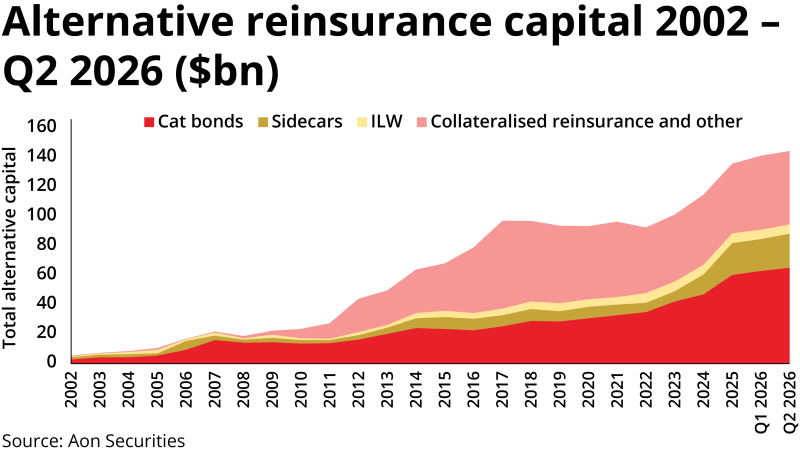
For ILS firms, this would be a positive as private ILS mandates typically carry more attractive fees than the more commoditised cat bond segment.
Beyond the cat market, this trend is also showing up in investors that are looking for diversification in other casualty and specialty lines, including cyber cat and data centres, although the bulk of long-tail driven capital is coming from a different segment.
Long-tail interest is outpacing deal volumes
The long-tail ILS market is experiencing a surge in popularity, with increasing leverage being built into casualty sidecar structures, as this publication covered during the Monte Carlo Rendez-Vous.
Four casualty sidecars have closed this year, according to the Insurance Insider ILS sidecar tracker.
But with deals still being relatively bespoke and complex to transact, cedants may be able to secure trade-offs in their favour on investment risk given the amount of investor interest relative to supply.
And during an ILS roundtable hosted at the industry event, attendees were generally confident that investors in these structures were being "rational and co-operative" and looking to fund excess capital in such structures to avoid the risk of being subject to capital calls.
One challenge was identified as liquidity modelling in matching investment portfolios to underwriting risks, as well as creating alignment in looking for diversified long-tail portfolios to avoid over-exposure to problem spots such as commercial auto.
These three trends are illustrative of an ILS market looking for new directions to find growth. And while the pace of momentum may not be able to keep up with that of the quick-growth hard market years, as investment decisions become more nuanced, the outlook is still overall a positive trending one for both buyers and suppliers.
Got a tip for us? Reach out confidentially here.
Frequently asked questions
How much have UCITS cat bond assets grown?
The UCITS European fund structures are a significant and popular component of cat bond assets overall, and data from Plenum Investments shows that UCITS fund universe has gained around 24% in AuM in the past 12 months, reaching $21.1bn.
What has happened to cat bond pricing multiples?
Average pricing multiples fell to 1.8x in Q3 on light deal volume, according to Insurance Insider ILS data, the lowest since the second half of 2018.
How do cat bond spreads compare with high-yield corporate debt?
Even as spreads have fallen, there remains a clear lead of more than 325 basis points between cat bond spreads and high-yield corporate debt. However, it should be noted that subtracting expected losses (which averaged 3% in Q2 26) from gross cat bond spreads would now significantly erode that margin lead.
Why have some ILS managers stopped taking inflows?
Despite the accumulated capital returning to cat bond managers, with ILS firms mindful of the potential for supply to outweigh new issuance, some managers have moved to temporarily stop inflows as they move to retain some ability to be selective over deals in a softening market.
Why might capital pivot towards private ILS?
The compression evident in cat bond spreads is not just expected to keep sponsor interest high, it is also expected to drive more of a recovery in the private ILS segment, as existing investors confident in the space look for higher relative yields.
How many casualty sidecars have closed this year?
Four casualty sidecars have closed this year, according to the Insurance Insider ILS sidecar tracker.
What challenges were identified in long-tail ILS structures?
One challenge was identified as liquidity modelling in matching investment portfolios to underwriting risks, as well as creating alignment in looking for diversified long-tail portfolios to avoid over-exposure to problem spots such as commercial auto.
By Fiona Robertson and Liz Bury
22 September, 2026
Request your free trial today to unlock our complete intelligence platform. .svg)
More from the blog
View All Posts
Sompo Capital Markets ILS departures: the Aspen integration risk
Read More
ILS market scopes potential for data centre risk transfer
Read More