

Analysis summary
Will investor appetite for cat bonds fade in 2027? Not yet, sources say, but it could if spreads tighten further. Fresh capital is still arriving ahead of the 1 January renewals, including a mandate of around $500mn, and $13.9bn of maturities due in 2027 will hand managers more money to redeploy. Cat bond funds are also expected to return an estimated 8% to 10%, adding capacity through profits. Sources warn that managers will need discipline to hold spreads at current levels, and managers suggest soft-closing funds and being more selective to manage excess supply. Cat bond spreads remain more attractive than those on US high-yield debt. The Swiss Re Cat Bond Index returned 19.7% in 2023, 17.3% in 2024 and 11.4% in 2025, and UCITS cat bond assets have grown 8% to $21bn in the year to October.Subscribe to get comprehensive access to our exclusive analysis in the full platform.
Influx of capital, profits and maturities could create excess capacity in the market and squeeze spreads.
Cat bonds are continuing to attract fresh capital heading into the 1 January renewals, although a further softening of spreads next year could slow the amount of new interest, sources told Insurance Insider ILS.
Currently, interest is driven by cat bonds’ attractiveness relative to competing asset classes, where spreads are tighter and markets are more affected by broader macroeconomic factors.
Three years of solid performance is also supporting investor interest in the asset class, sources added.
These dynamics are unlikely to change the picture for many institutional investors. However, sources raised concerns that fresh investor appetite could begin to fade next year if spreads compressed further, and warned that discipline would be required from managers to maintain spreads at current levels.
Factors that could cause further spread compression include an influx of fresh capital, with sources adding that there is a ~$500mn mandate looking to deploy ahead of 1 January.
There are also $13.9bn of maturities slated for 2027, flooding managers with capital and applying further pressure on spreads, according to data tracked by Insurance Insider ILS.
Cat bond funds are also expected to deliver another clean year, with estimated returns of between 8%-10%, adding additional capacity through profits that would need to be redeployed if investors don’t take chips off the table.
While sources suggested the pace of new interest could be impacted if spreads compress further, there was more optimism over ongoing participation.
One source said that “ILS capital is sticky”, while another said they had “not heard of any meaningful redemptions expected to take place so far”.
Moreover, significant rate compression in the past couple of years has also limited managers' willingness to make further concessions on spreads.
One source said “the cat bond market has already felt the squeeze” with regard to pricing, and that discipline would be required to maintain current levels.
Managers suggested soft-closing funds to new capital, as well as greater selectivity over which cat bonds to participate in, as tactics to manage excess supply.
Bonds attractive versus competing asset classes
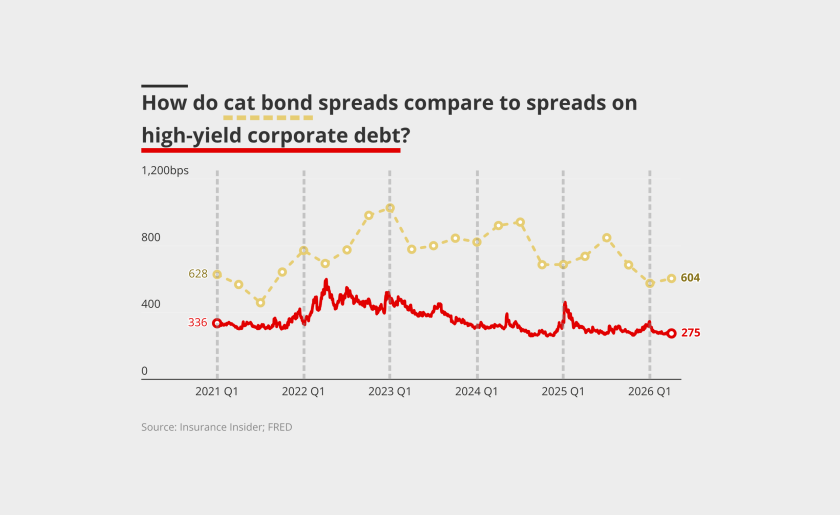
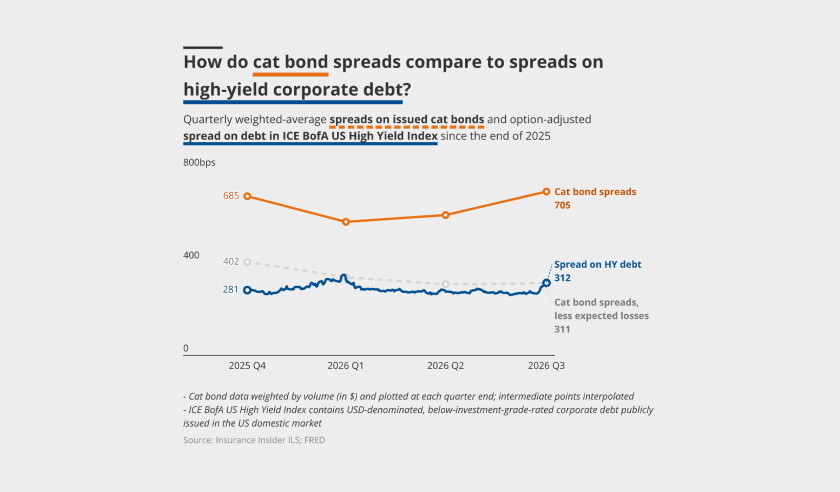
Investors are still considering allocations to catastrophe bonds, with spreads more attractive than those on US high-yield debt.
Franklin Templeton’s K2 Advisors added that current spreads and yields are attractive versus high-yield bonds, although it downgraded its Q4 outlook on cat bonds to “overweight” from “strongly overweight”.
One cat bond manager said: “If cat bonds were viewed as a standalone asset class, they could be considered unattractive to investors compared to previous pricing.
“However, they are viewed as part of a wider portfolio for investors, with US high-yield and other alternative asset classes, where spreads are tighter.”
Cat bond spreads minus expected losses have largely been above US high-yield spreads over the past 12 months. Gross spreads remain comfortably above high-yield equivalents, although net of expected losses, margins have compressed.
But cat bonds have also benefited from the high Secured Overnight Financing Rate (SOFR), the risk-free component of deals, which is currently just under 4% and provides around a third of total cat bond yields.
"Cat bond yields are still attractive with the support of the risk-free component, especially in comparison to competing asset classes," an ILS manager said.
Aside from their more attractive comparative spreads, cat bonds have demonstrated their diversification benefits as a non-correlated asset amid broader equity market instability.
Ongoing wars in Ukraine and Iran, which have spiked global fuel prices and shocked markets, have had no impact on the cat bond space, which has delivered positive returns for the last four years.
The market has also matured and maintained discipline on T&Cs, “which is also supporting continued interest in the asset class”, a source added.
One cat bond manager said: "Unlike previous soft cycles, we haven't yet seen any strange or unclear cat bond structures."
Positive returns drive interest
Fresh investor interest comes as the asset class has delivered three years of positive returns and is currently on track for a fourth consecutive year.
One cat bond manager said: “Investors tend to be backward-looking, so seeing three consecutive years of positive returns can often be the trigger to deploy in the market.”
The market returned 19.7% in 2023, 17.3% in 2024 and 11.4% in 2025, according to the Swiss Re Cat Bond Index.
UCITS assets under management, which are invested solely in cat bonds, have grown by 8% to $21bn in the year to October.
Most of this growth is likely to have been driven by coupon returns, however, with the Swiss Re Cat Bond Index returning 9.2% in the year to September.
Sources also added that, for some investors, spreads have reached a low enough point that they are no longer considering the asset class, whereas others are “still happy with their positions”.
Institutional investors and pension funds are generally still active in the space, while opportunistic investors such as hedge funds have largely left the market.
Overall, cat bonds continue to demonstrate their attractiveness despite softening spreads, thanks to their relative appeal, structural improvements and returns.
But any further compression could see interest begin to fade, with discipline from managers required to stem the downward trajectory.
Got a tip for us? Reach out confidentially here.
Frequently asked questions
Will investor appetite for cat bonds fade?
Any further compression could see interest begin to fade, with discipline from managers required to stem the downward trajectory.
What could cause cat bond spreads to compress further?
There are also $13.9bn of maturities slated for 2027, flooding managers with capital and applying further pressure on spreads, according to data tracked by Insurance Insider ILS.
How are cat bond managers responding to excess capital?
Managers suggested soft-closing funds to new capital, as well as greater selectivity over which cat bonds to participate in, as tactics to manage excess supply.
How do cat bond spreads compare with US high-yield debt?
Investors are still considering allocations to catastrophe bonds, with spreads more attractive than those on US high-yield debt.
Why are investors drawn to cat bonds?
Aside from their more attractive comparative spreads, cat bonds have demonstrated their diversification benefits as a non-correlated asset amid broader equity market instability.
What returns have cat bonds delivered?
The cat bond market returned 19.7% in 2023, 17.3% in 2024 and 11.4% in 2025, according to the Swiss Re Cat Bond Index.
Who is still investing in cat bonds?
Institutional investors and pension funds are generally still active in the space, while opportunistic investors such as hedge funds have largely left the market.
By Jai Singh
26 October, 2026
Request your free trial today to unlock our complete intelligence platform. 
More from the blog
View All Posts
Bond sponsors adding soft-market features while spreads hold up
Read More
ILS market scopes potential for data centre risk transfer
Read More