



Opinion
This sample opinion piece shows how we make sense of major capitalmarkets moves for ILS readers. Nuveen’s acquisition of Schroders brings a leading US asset manager together with one of the City of London’s stalwarts — and a topfive ILS franchise. We explain why access to Nuveen’s powerful US distribution could reshape Schroders’ ILS growth path, and what consolidation among global managers means for future capital flows into the asset class.
Subscribe to get comprehensive access to insight, analysis, opinion and more across the full platform.
Access to Nuveen’s US distribution could support significant growth for its ILS franchise.
Nuveen’s £9.9bn ($13.5bn) offer for Schroders reflects a shift in the asset management world that, while complex for firms to navigate, overall is positive for ILS.
For Schroders’ ILS activities specifically, access to Nuveen’s US distribution could support significant growth.
Meanwhile, with alternatives increasingly seen as an important component in a total portfolio, ILS managers stand to benefit from the tailwinds.
The Nuveen-Schroders deal can be seen as defensive. It looks like a bid for scale, as active equity managers are significantly pressured on margin from lower-cost passive strategies.
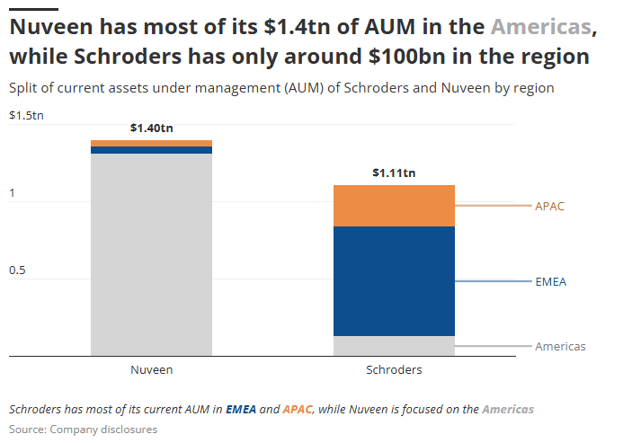
The combined firm will achieve scale of $2.5tn in assets under management (AuM), adding Nuveen’s $1.4tn and Schroders’ $1.1tn.
The messaging around the deal focused strongly on complimentary geographic coverage and investment specialties.
Johanna Kyrklund, group CIO at Schroders, noted “mirror opposite geographic footprints and investment capabilities” between the firms, in a video release about the deal.
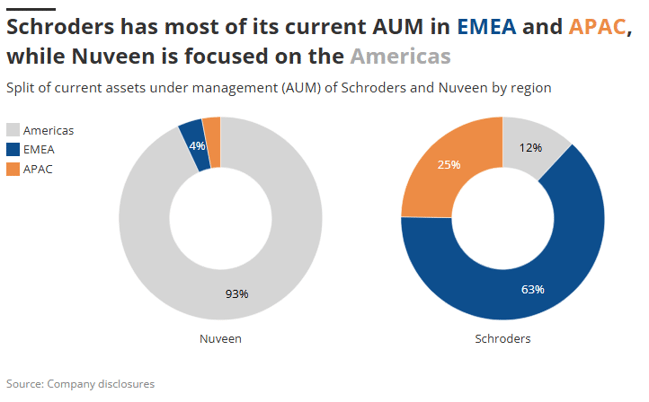
Most of Nuveen’s AuM hails from the Americas (93%), while Schroders’ assets stem from Europe (63%), the UK (25%) and Asia Pacific (12%).
Schroders currently operates from 38 locations globally, across Europe, the Middle East and Africa, Asia and Australia, and the Americas.
Schroders' London office was anointed as non-US group headquarters of the combined business, even as the firm will de-list from the London Stock Exchange.
Meanwhile, a co-operation agreement states “no material reduction” in Schroders staff for at least two years post-completion.
For the Schroders ILS unit, the lack of a parallel within Nuveen means there is an even better chance of avoiding disruption from the consolidation.
There are currently around 3,100 professionals across Nuveen and Schroders.
Schroders will continue as a standalone business for 12-18 months post-completion, while its new owners assess opportunities for collaboration and integration.
Schroders entered ILS with the acquisition of a 30% stake in Swiss ILS manager Secquaero in 2013, later increasing its holding in the firm to 50.1% in 2016.
In 2020, Secquaero CEO Dirk Lohmann stepped back, taking a newly created role of chairman, as Stephan Ruoff was appointed CEO of the ILS unit. Lohmman confirmed his retirement from the firm on LinkedIn last week.
Commenting on the Nuveen-Schroders deal, Richard Oldfield, group CEO at Schroders, said: “You will continue to deal with the same Schroders teams, with the focus on performance, service and long-term outcomes.”
Oldfield continues as CEO, joining Nuveen’s executive management team and reporting to William Huffman, Nuveen’s CEO.
Private markets are emphasised
In private markets specifically, combined AuM for the two firms is $414bn, adding Nuveen’s $316bn and Schroders’ $98bn.
This makes it “one of the industry’s largest alternatives platforms, with access to capital increasing capacity to support investment in private assets globally”, the deal release said.
Private markets and alternatives are a growing focus for asset managers, rising in importance as fees on equity investing are falling. The asset class is also proving its purpose, as equity markets' volatility persists.
Nuveen-Schroders will unlock new US distribution avenues for Schroders ILS, creating strong future growth potential for the alternatives platform.
ILS accounts for around $6.8bn of Schroders’ AuM, as of 1 January.
Meanwhile, Nuveen is asset manager for Teachers Insurance and Annuity Association of America (TIAA), with TIAA having a history of investing in ILS.
As long ago as 2009, when it was TIAA-CREF, the scheme said it valued ILS’s strength as a diversifier within a much larger portfolio.
The closest M&A parallels within the ILS market in recent years are BNP Paribas’ buyout of Axa IM, still in the integration process after closing last July; and the Amundi-Pioneer combination in July 2017. Growth within the Pioneer ILS funds has been steady since, going from $1.7bn in 2017 to $3.5bn at January 2026, per this publication’s ILS Fund Manager directory.
For ILS managers, the trend towards consolidation among asset managers signals the potential for more buyouts, especially when combined with a growing emphasis on private markets and alternatives.
At a premium of approximately 34% to the closing price of 456 pence per Schroders share, on 11 February, the price of the deal looks palatable on both sides.
In this context, independent ILS managers may start to look and feel ever more attractive as an addition for an acquisitive firm.
By Liz Bury
February 16, 2026
Request your free trial today to unlock our complete intelligence platform. .svg)

Industry and financial markets factors will support ILS growth in 2026
Read More
ILS market scopes potential for data centre risk transfer
Read More.png?length=360&name=Feature%20image%20(sharing%20size).png)