


Analysis summary
What does Willis Re gain from buying BMS Re's US business? Time, mainly. The deal hands the start-up a 220-person team, a client base and real cashflows in the world's largest insurance market, pulling forward the point at which it reaches breakeven. This analysis shows why the asset still carries elevated risk, having shrunk over two years after losing most of the revenues from its biggest client and turned over its leadership twice, how the ~$90mn revenue figure attached to the book is disputed by rivals, and what Willis Re must do to hold the producers that competing brokers are already targeting. It delivers fast insight on what the disposal does for BMS, and why the path to building a scaled reinsurance broking arm remains narrow even with the deal done.Subscribe to get comprehensive access to our exclusive analysis in the full platform.
The acquisition allows Willis Re to jump ahead on its progress to breakeven, but there are risks to manage.
Willis Re's acquisition of BMS Re's US operations is a qualified win for the start-up.
M&A is like a time machine for a start-up, allowing it to leap forward.
Overnight, it gives Willis Re a 220-person team, a client base and real cashflows in the world's largest insurance marketplace.
Back in April 2024, I argued in a broadly sceptical piece that broking start-ups that try to build from zero do not fare as well as buy-and-builds, and that there was nothing for a Willis Re-boot to buy.
Well, Willis Re found something to buy. And that will accelerate the j-curve and pull forward the point where the start-up is breakeven.
But it brings new kinds of risk the firm will have to effectively manage.
Willis Re is putting down real cash for a carve-out deal on a business that has been shrinking for the last two years, after losing most of the revenues from its biggest client CRC, and that lacks a CEO.
It is betting that the core of the business is better than the recent track record.
And it is backing itself to persuade key staff that they should stay with Willis Re through the disruption of the carve-out, spurning offers from rivals seeking to lure them away.
Willis Re sponsor Lucy Clarke (characteristically) spent a lot of time trying to win the hearts and minds of BMS Re's US staff base pre-deal.
Nevertheless, the bar for execution is high.
As such, the move only modestly flexes the overall prospects for Willis Re.
The path to success remains narrow, but it is now shorter and has a few new landmines to sidestep.
Willis Re: A US accelerant with new risks
Willis Re was launched in December 2024 as a joint venture between buyout firm Bain and WTW, with the aim of building a new force in reinsurance broking that would ultimately be folded into Willis.
To date the business has focused on talent acquisition via individual hires and team lift-outs, with London and Bermuda the key focal points.
Buying in the US now effectively accelerates its build-out, sparing it the cash burn as it frontloads costs with hiring and then seeks to win business in the most competitive market in the world.
But the state of the asset creates an elevated risk profile for the deal.
BMS Re in the US is understood to have suffered negative organic growth over the last couple of years, with the loss of some key clients. It has also suffered from an outflow of talent, without commensurate hiring to offset this.
The unit's biggest client, CRC, was worth high-teens millions of dollars of brokerage at its peak. However, the vast majority of this business has been lost to Guy Carpenter over the last two years.
The leadership team has also turned over twice. Pete Chandler stepped down from the top job in January 2024.
Brad Melvin was put in place as CEO of BMS Re US in November 2024, but left the firm suddenly in July, as the Willis Re deal came into view.
Sources have also pointed to a pattern of key defections. Desmond Bohan, the second most senior broker working on CRC after Chandler, left for Guy Carpenter. Dallas-based Cory Anderson left for Aon. North Carolina-based JJ Johnson, another key producer, also left.
Chief actuary Kirk Conrad, meanwhile, left to work for CRC's MGA business.
Sources with visibility of the sale talks said that the carve-out deal was agreed on a book with ~$90mn of revenues.
Multiple rival broking sources argued that the book is now significantly smaller than that headline number when marked-to-market for defections.
However, it should be noted that it has become a standard practice of senior reinsurance broking leaders to claim in private discussions that their rivals are exaggerating the size of their books.
Willis Re and BMS have not provided any numbers publicly on the size of the business or the valuation of the deal.
Willis Re and Bain must have got comfortable on the financials through due diligence or feel that the deal price provides sufficient margin of error to take the risk.
The retention of the key staff is the crux.
Sources said that Clarke held one-on-one calls with tens of staff at BMS Re to try to persuade them that Willis Re would be a good home for them.
It is understood that the signing of the deal was held up for a number of days as Willis Re waited on staff to sign not just retention agreements but also new employment contracts.
This kind of personal attention from one of the segment's most charismatic leaders will have had its effects, but producers will also have choices.
After Insurance Insider broke news that the two parties were in advanced talks, at least two rival brokers made approaches to BMS to acquire the US reinsurance operations.
These disappointed bidders are now likely to target key production talent, and rivals that did not show up to bid are likely running the same playbook.
Alongside this retention piece, Willis Re needs to revivify the business.
Momentum within brokerages is real. Brokers need to feel like they are playing for a winning team.
Willis Re will have to get its new American operations back on a firm footing and persuade the team to believe in what's coming next.
BMS: Disposal of a non-core asset
For BMS – and CEO Nick Cook – the deal represents a relatively elegant disposal of a non-core asset.
The staff and clients go to a perceived good home with no awkward conflicts to navigate.
In turn, BMS successfully monetizes a wasting asset, allowing it to hand off a problem child and focus its efforts on markets where it can win.
The US reinsurance arm struggled in an overcrowded marketplace with too many challenger brokers chasing the same business and suffered the strategic disadvantage of lacking a retail broking business to create leverage.
Divesting a relative underperformer will make it easier for BMS to tell its story to investors.
The group will likely be able to back the BMS Re US numbers out of its financials, removing a drag on organic growth, when the Preservation- and Eurazeo-backed broker looks for its next liquidity event.
Of course, it does have to find a way to manage the message around a retreat from a major market.
But the struggles of the US reinsurance broking business were already known. In addition, BMS has already effectively made it clear that it is going to try and optimise the perimeters of the group before any wider liquidity event, by placing its Canadian operations up for sale.
Selling the larger US team leaves BMS with around $50mn of revenues in reinsurance – with BMS Re now placed under the leadership of Aon alumnus Richard Dudley. The narrowed scope spans London, Latin America, a global property fac business, binders and Bermuda.
This is a small business – probably a single-digit percentage of the whole group – but more obviously complementary to its core franchise and capabilities than US treaty.
The strategic case for building a reinsurance broker
The strategic case for Willis to have a scaled reinsurance broking arm is as strong as ever.
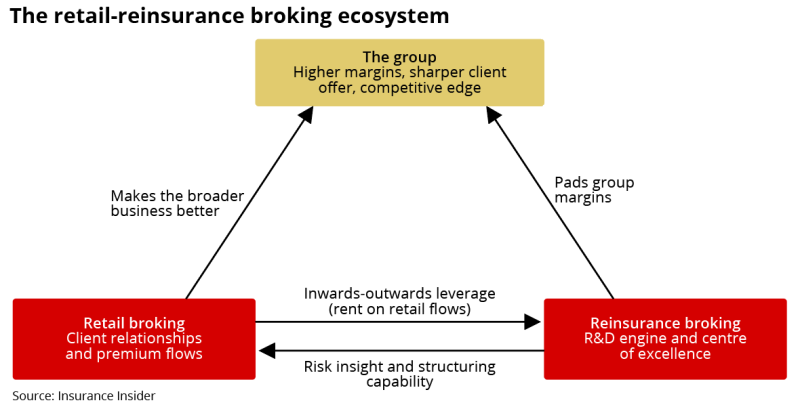
The inwards-outwards leverage allows retail brokers to take rent on their retail flows. And reinsurance brokers are R&D engines and centres of excellence that can make the broader business better, while padding group margins.
But the path to success remains difficult to cross.
The BMS deal makes the path shorter. But there are new land mines to avoid around staff defections and a cultural reset.
Got a tip for us? Reach out confidentially here.
Frequently asked questions
What does the acquisition give Willis Re?
Overnight, the acquisition gives Willis Re a 220-person team, a client base and real cashflows in the world's largest insurance marketplace.
When was Willis Re launched, and by whom?
Willis Re was launched in December 2024 as a joint venture between buyout firm Bain and WTW, with the aim of building a new force in reinsurance broking that would ultimately be folded into Willis.
How big is the book Willis Re is buying?
Sources with visibility of the sale talks said that the carve-out deal was agreed on a book with ~$90mn of revenues. Multiple rival broking sources argued that the book is now significantly smaller than that headline number when marked-to-market for defections.
Why does the acquired business carry elevated risk?
BMS Re in the US is understood to have suffered negative organic growth over the last couple of years, with the loss of some key clients. It has also suffered from an outflow of talent, without commensurate hiring to offset this.
What happened to BMS Re's biggest client?
BMS Re's biggest client, CRC, was worth high-teens millions of dollars of brokerage at its peak. However, the vast majority of this business has been lost to Guy Carpenter over the last two years.
What does BMS keep in reinsurance after the sale?
Selling the larger US team leaves BMS with around $50mn of revenues in reinsurance – with BMS Re now placed under the leadership of Aon alumnus Richard Dudley. The narrowed scope spans London, Latin America, a global property fac business, binders and Bermuda.
Why is a scaled reinsurance broking arm valuable to Willis?
The inwards-outwards leverage allows retail brokers to take rent on their retail flows. And reinsurance brokers are R&D engines and centres of excellence that can make the broader business better, while padding group margins.
By Adam McNestrie
20 August, 2026
Request your free trial today to unlock our complete intelligence platform. .svg)
More from the blog
View All Posts
Anatomy of a team lift Part II: The limits of defence
Read More
ReShare vehicles are growing slowly but a clear headwind for reinsurers
Read More