


Analysis summary
Who is buying AI liability insurance, and who is selling it? Around 10 markets now offer a standalone product, with submissions coming from household names as well as smaller tech-forward firms and medical facilities using AI-driven diagnostics. This analysis shows how the market splits between performance guarantee cover and traditional liability cover, why most underwriters can offer only $5mn to $25mn of limit against requests for tens or hundreds of millions, and how pricing is forming, with some aiming for around $100,000 per $1mn of cover for large insureds. It delivers fast insight on Deloitte's projection of a $4.8bn premium market by 2032, the spread of AI exclusions from Verisk and others, and whether AI liability ends up as a standalone line or absorbed into GL, E&O and cyber.Subscribe to get comprehensive access to our exclusive analysis in the full platform.
While it’s unsettled whether AI liability will be a standalone LOB, some insureds are trying to get ahead of the curve.

There has been a lot said about whether AI liability will be a standalone product like cyber or absorbed into existing lines of business like GL, E&O and cyber.
While many say the answer to the question is still up in the air, there are ~10 markets (and presumably more to come) offering a standalone product and seeing demand for the coverage.
Sources speaking to this publication reported seeing submissions from household names like Anthropic, JP Morgan, Walmart and Meta, among others, for AI liability coverage, often with requests for limits of tens or hundreds of millions of dollars.
On the other hand, smaller tech-forward companies and those in highly litigated industries like medicine are also looking to secure coverage for their AI use.
As of now, securing full coverage for many large submissions isn’t feasible with the amount of capacity in the market – most AI liability underwriters have available limits between $5mn and $25mn right now, sources said.
And the nascent nature of the technology means that claims history is essentially nonexistent, which makes taking headline risks more daunting for insurers.
Still, understanding who wants standalone AI liability coverage gives us a better picture of how this market could evolve under the right circumstances.
Deloitte predicts AI insurance could be a $4.8bn premium market by 2032. To put that number in context, the cyber market today is roughly ~$16bn in premiums.
Some are making bigger bets, with Testudo CEO George Lewin-Smith predicting that AI insurance will become “bigger than the cyber market, and potentially bigger than the entire P&C market,” he told this publication.
The market today
Among those offering AI-specific products are Amwins, Armilla, Mayflower Specialty, Munich Re and Testudo.
From a high-level perspective, these companies offer products that can be placed in two categories – performance guarantee coverage and traditional liability coverage for AI.
Performance guarantee coverage requires auditing a company's AI model and establishing a baseline standard for how the model should perform. Then, the policy pays if a model does not hit established KPIs. The insurance buyer in this case is usually an AI developer or vendor.
Munich Re aiSure and Armilla have model audit structures and offer performance guarantee products.
Then there is more traditional liability coverage for AI exposures. These policies respond when AI produces a harmful output that the insured is liable for.
Testudo and Mayflower’s products fit into this category. Armilla also has a liability product in addition to its performance guarantee product.
Amwins’ buyback product also falls into this category; it essentially works as an add-on to existing policies with AI exclusions, though it can also be purchased on its own. The wholesaler is currently working with around 10 E&S markets on its development.
Sources familiar with the AI liability market said clients seek coverage both because they’ve had exclusions implemented in their existing policies and because they’re trying to be proactive knowing there may be gaps in coverage.
A vast majority of the market, however, is still unaware of potential gaps, they added.
“The simplest way to explain it is that every time exposure compounds, you need to purchase more limit – just like when E&O, D&O or cyber was created,” Jeremy Epstein, CEO of Mayflower Specialty, told Insurance Insider US.
To get a better picture of how active the market is, one source said they see a handful of submissions per week and bind one policy per week. Others noted that they have not bound their first policies yet but are hoping to do so by the end of the year and into early next.
The consensus is that more exclusions or a headline loss in the market would drive submission numbers up.
Pricing and terms
In terms of pricing, some players in this space are aiming for roughly $100,000 per $1mn of coverage for large insureds, one source suggested, while others working with smaller companies may charge around a quarter of that figure.
Despite the business opportunity, underwriters canvassed by this publication were cautious about the new risk and said they are comfortable walking away rather than lowering rates to obtain new business.
Self-insured retentions between $1mn and $5mn are expected for large, financially mature companies, a source added.
Structuring the product this way is crucial to the health of the budding market, they said.
“We don’t want this market to disappear in 24 months. We want it to be something that endures for the next 10+ years.”
Early interest
Previous reporting from Insurance Insider highlighted that deployers of AI are likely to be held liable for harmful outputs.
The most cited example is the Air Canada case in which a judge found the airline, rather than its AI vendor, responsible for its erroneous output.
In the deployer category, medical facilities are an industry vertical showing early interest in AI insurance, market sources said, as many are implementing AI-driven diagnostic technology to help doctors assess a patient's injury or illness.
One cited being in talks with a regional chain of healthcare facilities expecting AI to be excluded from its corporate policies in 2027.
On the other hand, AI developers – those who build base models like OpenAI, Anthropic and others – are seeking coverage as well. These clients are highly likely to have AI excluded from commercial policies like GL, making a standalone product attractive.
One source said that large AI developers typically have eight-figure retentions on their general liability policies. If retentions are lower, there is likely a broad AI exclusion on the policy.
Many of the major developers have been operating with “as little insurance as possible up to this point,” one source said. But with IPOs on the horizon, and high-profile litigation against tech companies like Meta, there is more impetus to get protected.
Standalone or embedded
Most insurance policies today are still silent on AI, meaning they neither explicitly affirm nor exclude coverage. In a report released earlier this month, Aon estimated that 90% of AI exposures are silent.
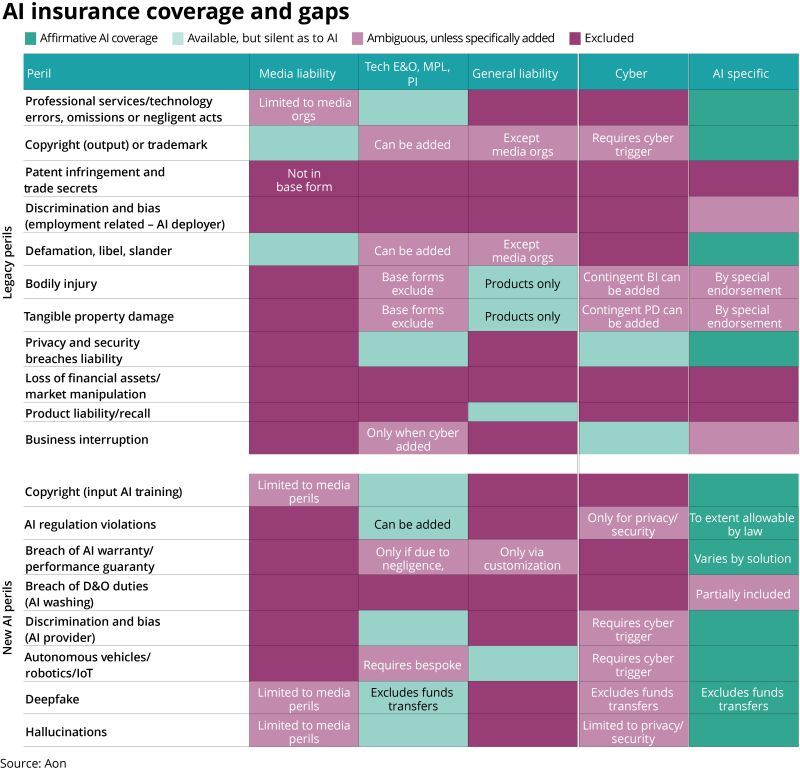
But there is still a chance that insurers will overwhelmingly absorb AI risk into existing products. For example, CFC announced in June that it would be embedding affirmative AI coverage, introducing explicit AI-related language into seven policies.
There are signs that some insurers are going in the opposite direction. As of January 2026, Verisk has come out with a generative AI exclusion for commercial general liability policies. This publication also reported that it was in the process of drafting an agentic AI exclusion.
In a recent interview, Apollo ibott commercial president Chris Moore said that he believes exclusions will become widespread in 2027. Others speaking to this publication agreed and emphasized that reinsurers will drive the exclusions.
This publication also reported that brokers started seeing AI exclusions pop up, particularly in E&O policies.
Some have questioned whether these policies retain value without AI coverage. One of the arguments against a standalone market is that certain policies, by design, would have no value with the exclusion of AI.
Take a lawyer’s professional liability policy for example. As the use of AI becomes ubiquitous in the legal profession, would there still be value in a lawyer’s E&O policy if any use of AI means insurers are off the hook for a claim?
Cyber is another example. A broad AI exclusion on cyber would theoretically render the policy useless as more threat actors use AI to aid in cyberattacks, sources said.
That said, “the most sophisticated companies will likely buy standalone towers for AI,” said Moore, considering these clients will want bespoke solutions that meet their specific exposures.
“They're not going to let insurance stop them in their journey and the progress in their technology,” he added.
That is what appears to be happening now.
For many companies on the forefront of tech, it isn’t worth waiting and seeing where things might be absorbed in a traditional GL, cyber or E&O policy. They want to know, affirmatively, that they will be covered in the event of an AI-driven incident, sources said.
A lot is yet to be determined. What does seem likely is that AI liability will exist as a standalone product in the long run.
The question is whether it will be a niche specialty product or one that supersedes the premiums of the existing P&C market.
Got a tip for us? Reach out confidentially here.
Frequently asked questions
Who offers AI liability insurance?
Among those offering AI-specific products are Amwins, Armilla, Mayflower Specialty, Munich Re and Testudo.
How much AI liability capacity is available?
As of now, securing full coverage for many large submissions isn’t feasible with the amount of capacity in the market – most AI liability underwriters have available limits between $5mn and $25mn right now, sources said.
What is AI performance guarantee coverage?
Performance guarantee coverage requires auditing a company's AI model and establishing a baseline standard for how the model should perform. Then, the policy pays if a model does not hit established KPIs. The insurance buyer in this case is usually an AI developer or vendor.
How much does AI liability insurance cost?
In terms of pricing, some players in this space are aiming for roughly $100,000 per $1mn of coverage for large insureds, one source suggested, while others working with smaller companies may charge around a quarter of that figure.
How big could the AI insurance market get?
Deloitte predicts AI insurance could be a $4.8bn premium market by 2032. To put that number in context, the cyber market today is roughly ~$16bn in premiums.
Who is held liable for harmful AI outputs?
Previous reporting from Insurance Insider highlighted that deployers of AI are likely to be held liable for harmful outputs. The most cited example is the Air Canada case in which a judge found the airline, rather than its AI vendor, responsible for its erroneous output.
Will AI exclusions become widespread?
In a recent interview, Apollo ibott commercial president Chris Moore said that he believes exclusions will become widespread in 2027. Others speaking to this publication agreed and emphasized that reinsurers will drive the exclusions.
By Olivia Royle
1 September, 2026
Request your free trial today to unlock our complete intelligence platform. 