


Analysis summary
How is the London company market performing compared with Lloyd's? Its premiums have plateaued while Lloyd's has kept growing, reopening a gap that had nearly closed in the early 2020s. This analysis of the International Underwriting Association's 2026 London Company Market Statistics Report shows Lloyd's GWP at £58bn in 2025, 11% higher than in 2023, against £49bn for the company market including controlled business, up only 2% over the same period. It delivers fast insight on why treaty premiums fell 5% year on year while D&F rose 2%, how growth in delegated-authority business slowed to 1.6%, and which classes grew or shrank, from flat liability and falling property to rising political risk/credit, construction and cyber.Subscribe to get comprehensive access to our exclusive analysis in the full platform.
IUA data shows London premium growth outside of Lloyd’s has plateaued.
On Tuesday, the International Underwriting Association (IUA) released the 2026 edition of its London Company Market Statistics Report – and it shows that the company market is now on a vastly different trajectory to that of Lloyd’s.
This report provides an annual overview of the amount of specialist (re)insurance business that’s being written in London outside of Lloyd’s and for a few years, it looked like company market premiums might overtake Lloyd’s.
After Lloyd’s published its annual results for 2025, we asked: could the Corporation really continue to push for top-line growth in a radically changing pricing environment?
At H1 2026, we got our answer. Aggregate Lloyd’s gross written premium (GWP) in the first half of this year was up 7% – despite rates dropping 7% on a risk-adjusted basis during the same period.
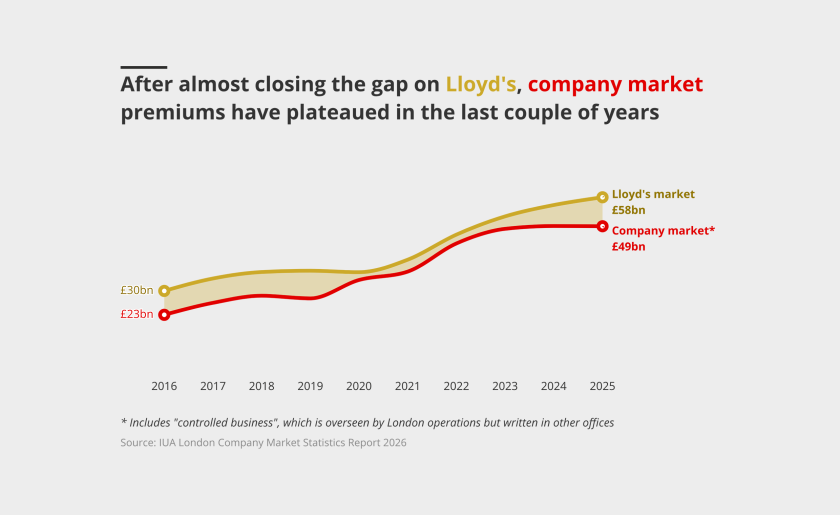
The company market has taken a different approach. In the early 2020s, the aggregate tally of ex-Lloyd’s premium published by the IUA started to come close to the Lloyd’s total; that gap has opened again over the last two years, as company market premiums have plateaued.
Lloyd’s GWP stood at £58bn in 2025 – 11% higher than in 2023. In contrast, the company market total (inclusive of what the IUA calls "controlled business") was £49bn – only 2% up over the same period.
On the question of growth vs rate adequacy, IUA CEO Christopher Jones was unequivocal. In the introduction to this year’s report, he said: “Underwriting discipline is the watchword and is it in conditions such as these that the expertise and scale of London come to the fore.”
Why was there little to no top-line growth in the company market last year? The IUA provides a number of helpful categorical breakdowns of premiums written which help us answer this question.
Firstly, by type of placement: treaty business has flatlined in the last couple of years, as well as (re)insurance written under direct & facultative (D&F) contracts.
Treaty premiums were down 5% year-on-year, while D&F volume was up 2%.
This divergence reflected different pricing stories in each placement category. Per the IUA’s survey of the market, D&F rates have been “flat for two years”; in contrast, treaty rates “rose significantly in 2024 but recorrected in 2025”.
While it remained small in absolute terms, an uptick in delegated-authority business was a factor in the company market getting closer to Lloyd’s in aggregate.
Premiums in that category of the IUA’s survey grew by double-digit annual rates between 2018 and 2021. It hit that benchmark again in 2024, with a dip in between.
Last year, however, there was a more modest 1.6% increase.
Finally, the IUA provides a breakdown of company market premiums by class of business. For these, "controlled premiums" – those written in other offices but overseen by London – are excluded.
In general, there was a marked contrast between the market’s larger and smaller classes. Liability premiums were flat and property premiums were down, while volumes in political risk/credit, construction and cyber – among other lines that represent a small share of the overall market – were up.
Marine, aviation and renewable energy was the outlier among the market’s main classes: it was the second largest by premium during 2024 and grew by a couple of percentage points year on year. With around £6bn of 2025 premium, marine is the largest individual class within that broader segment.
It’s worth noting that it’s not possible to do a complete comparison between the London company market and the Lloyd’s market based on this annual publication. The IUA publishes no data on aggregate claims and losses, and so there is only one side of the equation.
With that caveat, the divergence in underwriting approaches remains striking.
As Lloyd’s management sticks to its initial growth projections for this year – even as they repeatedly warn of the need for discipline – and IUA leadership encourages underwriters to apply the brakes, the two markets look set to grow even further apart as 2026 comes to a close.
Got a tip for us? Reach out confidentially here.
Frequently asked questions
How big is the London company market compared with Lloyd's?
Lloyd’s GWP stood at £58bn in 2025 – 11% higher than in 2023. In contrast, the company market total (inclusive of what the IUA calls "controlled business") was £49bn – only 2% up over the same period.
What does the IUA's London Company Market Statistics Report cover?
The IUA's London Company Market Statistics Report provides an annual overview of the amount of specialist (re)insurance business that’s being written in London outside of Lloyd’s and for a few years, it looked like company market premiums might overtake Lloyd’s.
Is the London company market catching up with Lloyd's?
The company market has taken a different approach. In the early 2020s, the aggregate tally of ex-Lloyd’s premium published by the IUA started to come close to the Lloyd’s total; that gap has opened again over the last two years, as company market premiums have plateaued.
How did treaty and D&F premiums change in the London company market?
Treaty premiums were down 5% year-on-year, while D&F volume was up 2%. This divergence reflected different pricing stories in each placement category. Per the IUA’s survey of the market, D&F rates have been “flat for two years”; in contrast, treaty rates “rose significantly in 2024 but recorrected in 2025”.
How fast is London company market delegated-authority business growing?
Delegated-authority premiums in the IUA’s survey grew by double-digit annual rates between 2018 and 2021. It hit that benchmark again in 2024, with a dip in between. Last year, however, there was a more modest 1.6% increase.
Which London company market classes grew in 2025?
Liability premiums were flat and property premiums were down, while volumes in political risk/credit, construction and cyber – among other lines that represent a small share of the overall market – were up.
What did the IUA's CEO say about underwriting discipline?
On the question of growth vs rate adequacy, IUA CEO Christopher Jones was unequivocal. In the introduction to this year’s report, he said: “Underwriting discipline is the watchword and is it in conditions such as these that the expertise and scale of London come to the fore.”
By Ben Wylie
17 September, 2026
Request your free trial today to unlock our complete intelligence platform. 