


Analysis summary
Will private ILS investors pull back as property catastrophe rates fall? Not by much, according to sources. Some investors are taking profits ahead of the 1 January reinsurance renewal, mostly because of rate reductions, with a further 10%-15% cut anticipated. Overall appetite for the class remains strong, and the segment is expected to stay about flat at around $50bn, per Aon Securities. Some investors who left after losses in 2017-2021 are starting to reconsider, and private ILS strategies tracked by the ILS Advisers Index have delivered 9.3% in the nine months to September. Some investors are also rebalancing from cat bonds, where average spreads are down 41% from their Q1 2023 peak.Subscribe to get comprehensive access to our exclusive analysis in the full platform.
Some investors could return to private ILS, while others add to existing allocations.
Investors in private ILS will take some profits off the table ahead of the 1 January reinsurance renewal, although overall appetite for the class remains "strong", sources have told Insurance Insider ILS.
The size of the private ILS space is expected to remain about flat at the renewal versus 1 January 2026, at around $50bn, per Aon Securities.
Sources also indicated that some end-investors who had withdrawn from private ILS, after being burned by poor performance from 2017-2021, are now starting to consider re-entering the space.
Investors taking chips off the table
Private ILS investors are taking profits off the table, rather than reinvesting, mostly because of property cat rate reductions, with a further 10%-15% cut anticipated at upcoming 1 January reinsurance renewal, sources said.
Investors are taking profits "plus a bit of change" in some instances, with one source adding “it is clear now is the time to be taking chips off the table".
Luca Albertini, CEO at Leadenhall Capital Partners, said: "We have approached investors as part of our marketing process and a small number of them have said they are reducing their allocations because the premium is shrinking."
Property catastrophe rates reduced on average by 12% at 1 January 2026, versus a year earlier, with the cut coming on top of a 7% decline at 1 January 2025, according to figures from broker Marsh Re.
Sources added that in the years since Hurricane Ian, investors have matured and become more educated about market dynamics, and they now understand that adding to allocations in a soft market can create over-capitalisation and apply further downward pressure on rates.
“Investors are more disciplined now and understand how to manage the cycle,” said Michael Knecht, investment managing director at Cambridge Associates.
Across the ILS investor base, US allocators, who are generally opportunistic in approach, have scaled back more readily than their counterparts in Europe, Asia or Australia, who tend to favour more strategic, longer-term allocations to ILS.
However, despite the reduction from some investors, overall private ILS capital is expected to remain stable heading into the renewal period, with no needle-moving inflows or outflows expected.
One manager said: “We haven’t and don’t expect to see any major outflows from existing investors.”
“Instead, we are expecting more strategic asset allocation, with investors looking to scale and rebalance their positions,” the manager added.
There has been a steady beat of allocations into private ILS since the start of 2025, including the Florida Retirement System Pension Plan awarding $200mn each to Tangency's Select Markets Access Fund and Nephila's Navaura Fund.
California pension plan Calpers, meanwhile, awarded a private ILS mandate in the hundreds of millions of dollars to Tangency, this publication reported in October 2025.
The fresh allocations have helped the private ILS segment to grow to ~$50bn as of the end of Q2 2026, from ~$45bn at the end of 2016, according to Aon Securities.
Investors reconsidering private ILS
Meanwhile, several investors who redeemed ILS allocations after suffering losses in the period 2017-2021 are now reconsidering their position, after three years of stellar performance for 2023-2025, and with 2026 on course to be a fourth strong year, sources said.
One source said: “We’ve had conversations with some of those investors who are now looking at the space again after a few years of solid performance."
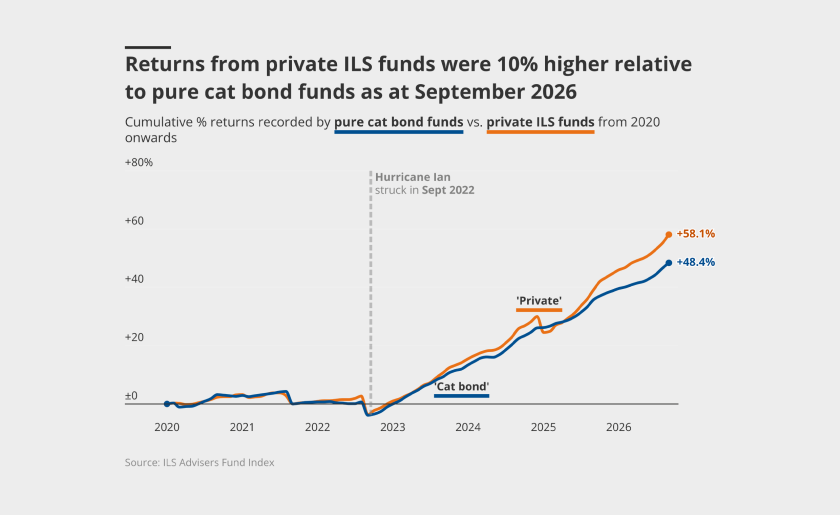
Private ILS strategies tracked by the ILS Advisers Index have delivered 9.3% in the nine months to 31 September.
The cohort of funds that cover private ILS generated profits for investors of 12.5% in full-year 2025, following returns of 13.7% in 2024 and 14.7% in 2023.
Knecht said: “Investors lost a bit of trust during 2017-2021, but some of that trust is returning.”
For 2026, sources said low risk private strategies are on course to deliver returns in the high single digits to low double digits, assuming no late major cat event.
Medium risk strategies are expected to generate returns in the mid-teens to low 20s, and higher risk strategies are on course to deliver 20%-30% for 2026.
However, some investors who left the space after poor years of performance are currently closed off completely to ILS due to the negative experience and may take years to return, or never return at all.
This is due to believing that their experience with one ILS manager was indicative of the broader experience they would likely have with other ILS managers, sources noted.
One manager said: “We’ve spoken with enough investors to know that all it takes is one bad manager to upset the apple cart and how they view ILS more broadly.”
Rebalancing portfolios to private ILS
Meanwhile, some investors are moving to rebalance their ILS portfolios to give a stronger weighting to private ILS over catastrophe bonds, either by moving capital from one strategy to another or by topping up their private ILS holding with small additions, sources said.
Albertini noted that Leadenhall has one investor in the process of moving $20mn from a cat bond fund into a private fund.
Alexandre Bruls, head of private ILS portfolio management at Twelve Securis, said: “For investors with lower liquidity requirements, allocating a portion of their portfolio to private ILS may be an attractive option.”
This shift is driven by the stronger returns available in private ILS compared to cat bonds.
In the cat bond space, average spreads reduced to 604 basis points (bps) in Q2 2026, down by 41% from a peak of 1,026bps as of Q1 2023, data tracked by this publication shows.
Sources noted a preference from investors who are pivoting into private ILS for remote risk strategies that have a similar risk profile to cat bonds.
“This could provide exposure to potentially higher returns available in the private ILS market and may help offset the impact of cat bond spread compression," Bruls noted.
However, for some investors, investment guidelines on liquidity mean that a private ILS allocation is not in scope.
Where relevant though, investor sentiment to private ILS remains strong, while still tempered by the overall reinsurance rate softening environment.
Got a tip for us? Reach out confidentially here.
Frequently asked questions
How big is the private ILS market expected to be at the 1 January renewal?
The size of the private ILS space is expected to remain about flat at the renewal versus 1 January 2026, at around $50bn, per Aon Securities.
How much did property catastrophe reinsurance rates fall at 1 January 2026?
Property catastrophe rates reduced on average by 12% at 1 January 2026, versus a year earlier, with the cut coming on top of a 7% decline at 1 January 2025, according to figures from broker Marsh Re.
Why are some investors reducing their private ILS allocations?
Luca Albertini, CEO at Leadenhall Capital Partners, said: "We have approached investors as part of our marketing process and a small number of them have said they are reducing their allocations because the premium is shrinking."
What returns have private ILS funds generated?
The cohort of funds that cover private ILS generated profits for investors of 12.5% in full-year 2025, following returns of 13.7% in 2024 and 14.7% in 2023.
What returns are expected from private ILS strategies in 2026?
For 2026, sources said low risk private strategies are on course to deliver returns in the high single digits to low double digits, assuming no late major cat event. Medium risk strategies are expected to generate returns in the mid-teens to low 20s, and higher risk strategies are on course to deliver 20%-30% for 2026.
How far have cat bond spreads fallen?
In the cat bond space, average spreads reduced to 604 basis points (bps) in Q2 2026, down by 41% from a peak of 1,026bps as of Q1 2023, data tracked by Insurance Insider ILS shows.
Why are some investors shifting from cat bonds to private ILS?
This shift is driven by the stronger returns available in private ILS compared to cat bonds.
By Jai Singh
16 November, 2026
Request your free trial today to unlock our complete intelligence platform.