



By Rebecca Perkins Rachel Dalton Ben Wylie
December 18, 2025
Transactions reveal the attractiveness of the "underwriting plus" business model.
The past year has brought heightened M&A activity in the Lloyd’s market, as 2025 transactions underscored the attractiveness of the “underwriting-plus” business model amid a slowdown in dealmaking momentum in the broking space.
Our final instalment in this year's M&A Update series is powered by Insurance Insider’s comprehensive deal database, the M&A Deal Tracker.
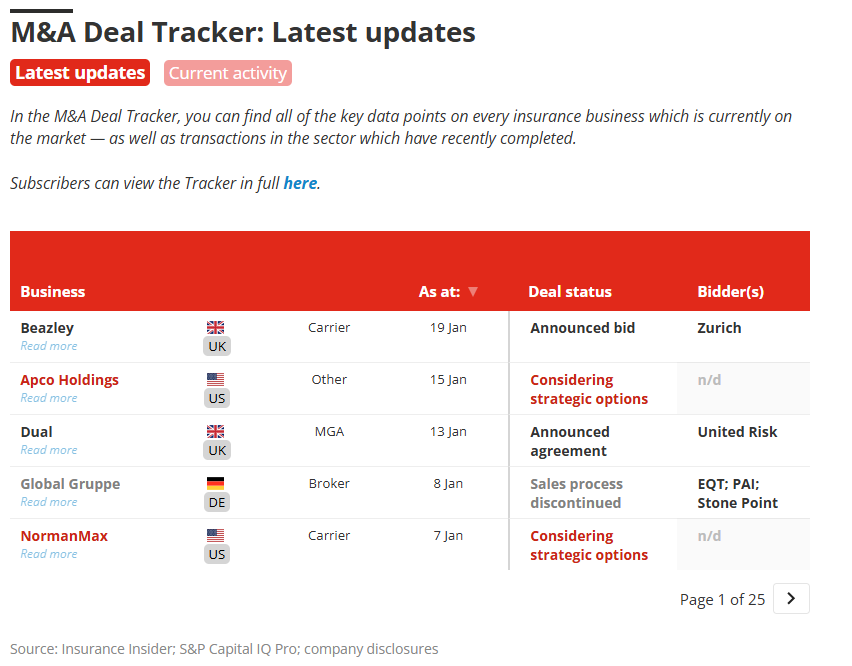
Lloyd’s M&A: A busy year for deals
Looking back at the Lloyd’s market in 2025, it has been a notably active year for M&A and strategic transactions.
The likes of Aspen, Atrium, Apollo, Convex, Inigo and IQUW have all made headlines with deals that underline that capital remains willing to back Lloyd’s businesses deemed attractive.
Earlier this year, Insurance Insider identified a cohort of syndicates backed by private equity (PE) investors who were expected to come to market as their current owners look to realise returns on their investments.
With 2026 around the corner, several of those businesses at 1 Lime Street have already been sold.
This publication tipped that the carrier M&A cycle was about to kick into gear as long ago as July 2024, and there were several reasons for that.
The first was that growth was about to get harder, and excess capital would be burning a hole in executives’ pockets. Multiples have strengthened, giving would-be acquirers strong currency to finance any deals.
This was quite the pivot to predict at that time, when brokers had drawn the M&A headlines far more often.
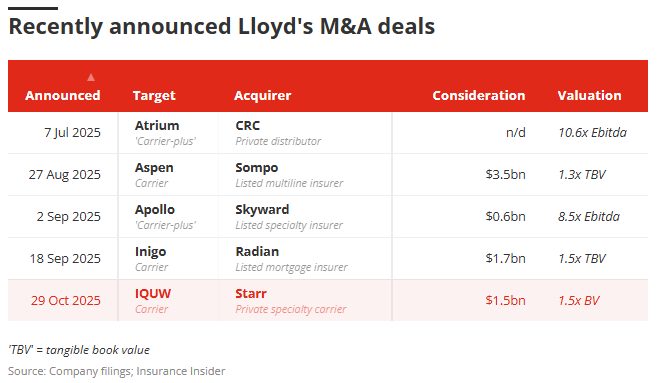
In July, US wholesaler CRC Group agreed to acquire Atrium’s managing agency – previously owned by Stone Point, among other investors.
The deal demonstrated that there is clearly interest in what we have dubbed the “carrier-plus” model.
Atrium showed how the Lloyd’s system can lend itself well to an agency sale deal, without needing complicated Fidelis-style bifurcations. The carrier effectively sold its agency/managing general agent-like operations to CRC, while Stone Point kept the risk-bearing corporate member.
But even Apollo or Aspen, which had more conventional sales, played up the fee-earning parts of their businesses in discussing their deals.
In September, mortgage specialist Radian announced its purchase of Inigo. Inigo’s sale to Radian marked another example of strategic capital moving into Lloyd’s. Having explored other options, Inigo ultimately agreed a transaction that provided synergies around capital deployment and diversification.
For Radian, Inigo can act as an “engine” through which to deploy excess capital generated from its profitable mortgage insurance business.
Convex’s deal with AIG was also an unexpected coupling. It demonstrated that the pool of potential Lloyd’s acquirers, as well as the ownership structures under consideration, is far wider than many would have anticipated at the start of the year.
Most recently, Starr confirmed that it would acquire IQUW from backers Aquiline and Abry in late October.
As a large strategic with capital to deploy following several profitable years, the deal achieves meaningful top-line expansion for Starr at a time when the insurance pricing cycle has made growing organically difficult.
The past year has demonstrated that Lloyd’s M&A is not dormant.
Capital is available but selective, and the businesses that transacted in 2025 were those able to clearly articulate underwriting quality, scale and strategic relevance.
UK broking M&A momentum slows
In 2025, the previously frenzied pace of UK broking M&A hit a downturn, with activity still ongoing but with a distinctly different tone.
In large part, the change in pace is due to the phenomenon of the PE “conveyor belt” slowing.
The phenomenon was first felt in the US but is now seen in the UK, as PE investors face more difficulty in securing target returns on their investments, leaving them holding broking assets for longer.
The difficulty in achieving those target returns is due to the relative maturity of the UK broking sector. With broking businesses now much larger and the sector more consolidated, the potential for Ebitda multiple arbitrage is smaller than 20 or even 10 years ago.
Debt is more expensive, meaning brokers’ borrowing – used to fuel aggressive growth – is now squeezing their margins. At the same time, the downturn in (re)insurance rates has dented brokers’ income.
The issue has manifested itself in various forms: fewer PE bidders in sales processes, a reduction in deal multiples, lengthier sale negotiations and even some shelved processes.
Perhaps the most high-profile victim of the downturn was PIB; owners Apax and Carlyle brought it to market early in the year but, despite initial interest from PE, and later bilateral talks with Gallagher, ultimately opted to end the sale attempt.
As the boil came off UK broking assets, PE investors looked elsewhere for a fragmented broking market in which to invest, with several significant deals in Germany during the year.
December deals
A number of major insurance deals have also been agreed in December. In the US, publicly traded broker The Baldwin Group announced that it would merge with CAC Group in a deal valued at over $1bn.
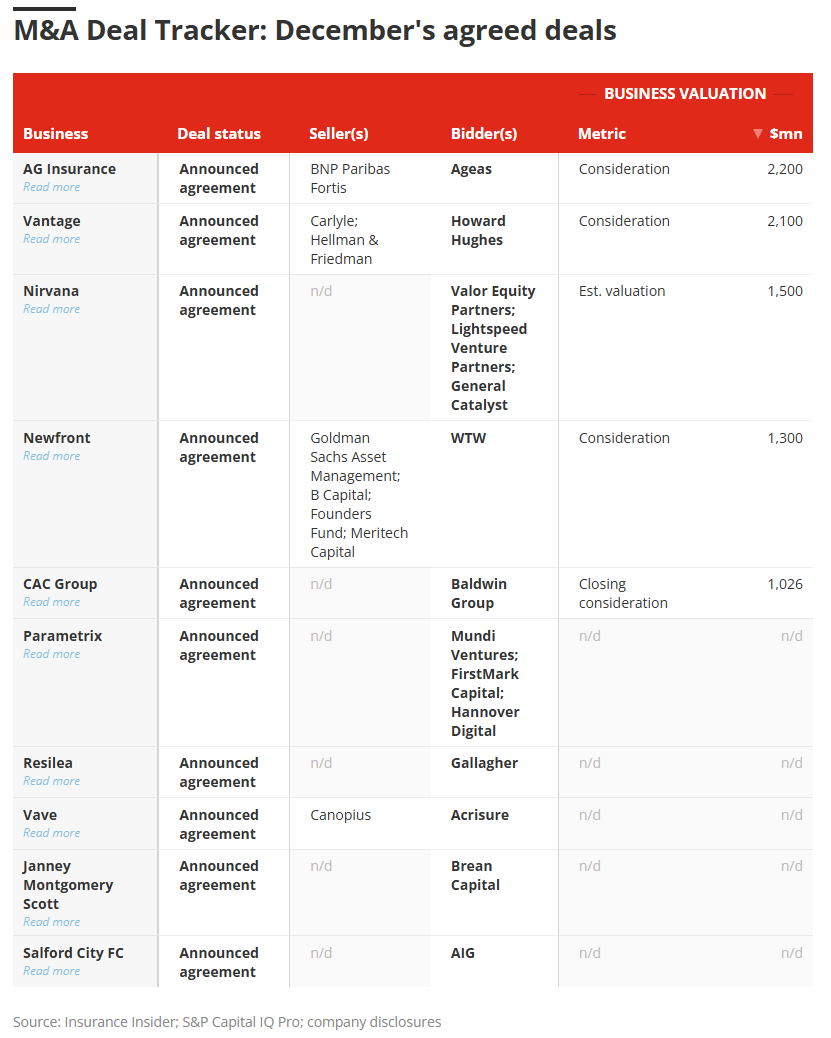
WTW also signed a definitive agreement to acquire San Francisco-based InsurTech broker Newfront, with upfront and contingent consideration payments due as part of the deal totalling $1.3bn.
Meanwhile in Europe, Ageas has agreed to acquire the 25% stake in subsidiary AG Insurance it did not own from BNP Paribas Fortis for EUR1.9bn ($2.2bn).
During December, this publication has revealed key developments in ongoing processes to the market.

Two weeks ago, Insurance Insider reported that Howden was in advanced talks to acquire US transactional liability specialist Atlantic Group. Sources said that the transaction will value Atlantic at over $500mn, including earnouts.
In recent days, we have also revealed that Floridian insurer SafePoint is considering a 2026 IPO, and that Aquiline-backed broker Relation Insurance has launched a strategic process.
It therefore looks like 2026 is unlikely to see a slowdown in deals.
Got a tip for us? Reach out confidentially here.