




The breadth of strategies targeted by ILS start-ups signals where the industry is heading.
Macroeconomic influences, novel applications of technology and anticipated flows of private credit capital into the sidecar segment are among key factors that look set to shape the ILS industry in 2026.
Financial market cycles could benefit ILS
In a year-end commentary with read-across for the ILS industry, hedge fund research firm HFR said it expects hedge fund industry capital to grow to historic levels in 2026.
Risk-on strategies were supported by strong momentum in AI technology, among other influences. Risk-off factors included “liberation day” volatility, a sharp correction in cryptocurrencies and reversal of AI sentiment.
ILS managers will recognise this description. Sources anticipate that fundraising in 2026 will be supported by ILS’s proven ability to deliver uncorrelated gains even as financial market conditions fluctuate.
The ILS Advisers Index has gained 40.1% from January 2021 to end of November 2025. The index’s return for the 11-month period to end of November currently stands at 10.4%.
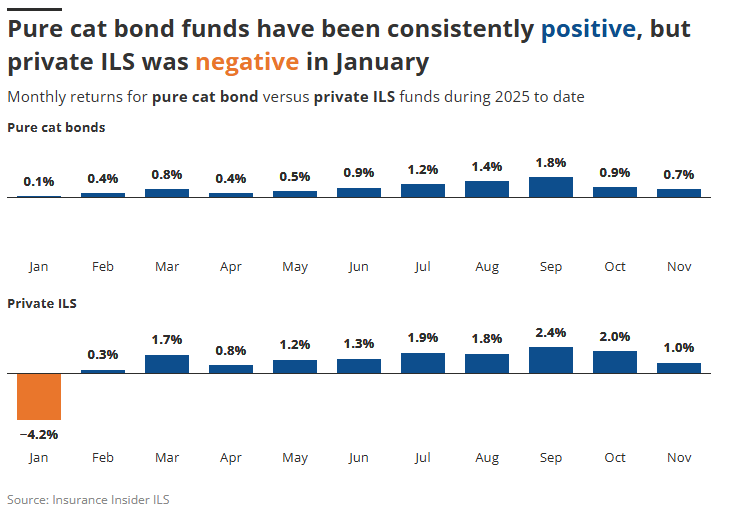
The impact of the January Los Angeles wildfires on private ILS strategies notwithstanding, the industry delivered compelling, non-correlated returns through a macroeconomically volatile year in 2025.
Additionally, the hunt for yield that emerges with lower bank rates is generally thought to support fundraising for total return-type strategies like ILS.
The US bank rate was cut by 0.25% to 3.5%-3.75% in December. The expectation is that the downward trend could continue this year, including if President Donald Trump pursues an agenda to appoint a low rate-friendly Federal Reserve chair.
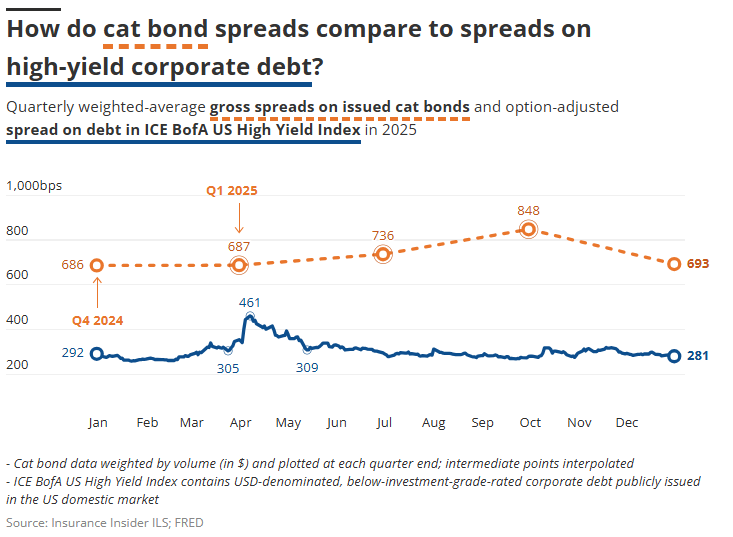
Meanwhile, and by way of comparison, average gross cat bond spreads remain well above those on offer from high-yield corporate bonds.
Multiple ILS start-ups are pursuing new avenues for the market
Several new ILS firms launched last year, with 2026 potentially a significant year of growth and development for these early-stage players. They include Hannover Re Capital Partners and a new ILS vehicle from Beazley – both Bermuda-based spin-offs of major global carriers.
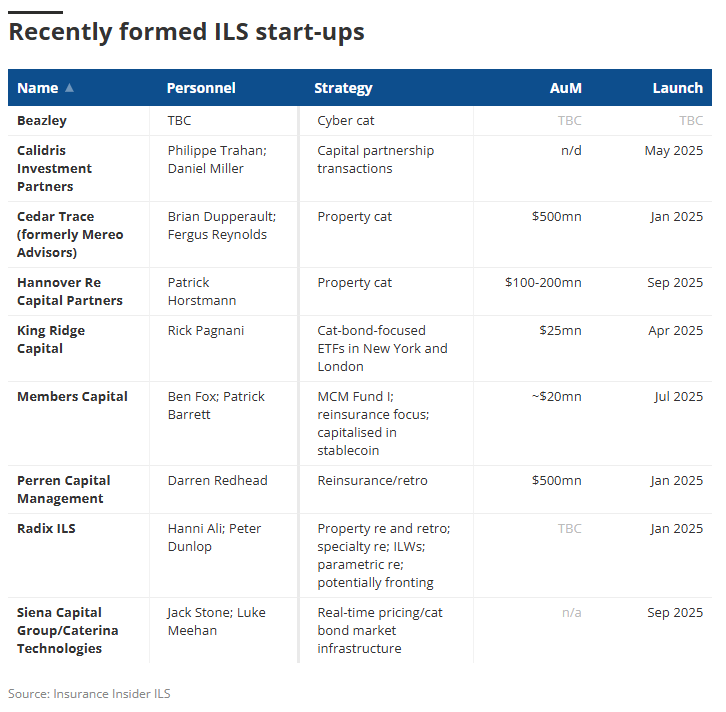
The carrier-linked launches can be seen partly as expressions of a broader market sentiment, whereby having an ILS capability is considered accretive to a carrier’s value.
Aspen CFO Nicolas Burnet hailed Aspen Capital Markets as a “financially attractive” component of its sale, after it was acquired by Sompo in August.
Meanwhile, in December, on the sale of Vantage to Hughes & Hughes, Carlyle executives noted Vantage had “diversified its business model through innovative insurance-linked strategies”.
The new wave of standalone managers are also ones to watch, with a wealth of ILS expertise lined up within the new ventures.
The breadth of strategies they are targeting provides a signal to where ILS is heading. Their strategies span short-tail property cat reinsurance and retro (Perren, Cedar Trace) to specialty reinsurance (Radix ILS) to longer-tail strategic partnership-type deals (Calidris) to fronting (also Radix).
Leveraging the latest technology is also at the heart of many of the business models of the next wave of ILS firms. Siena Capital is on a mission to introduce daily pricing to the cat bond market, MembersCap is aiming to tap pools of stablecoin assets, and King Ridge has helped to create the first cat bond ETFs.
Korra, the new software-as-a-service offering for casualty ILS, launched by Ledger Investing in December, aims to support technology-enabled placement and servicing.
And OpIngen, a joint venture of Jireh Risk Advisors and Strategic Risk Solutions, is offering an outsourced operations platform.
Casualty, specialty and multi-line sidecar growth is anticipated
The flow of capital coming into the sidecar market is a third key trend that is expected to shape the ILS industry through 2026.
There is a particular focus on transactions involving long-tail risks, where investors have an opportunity to manage the premium float.
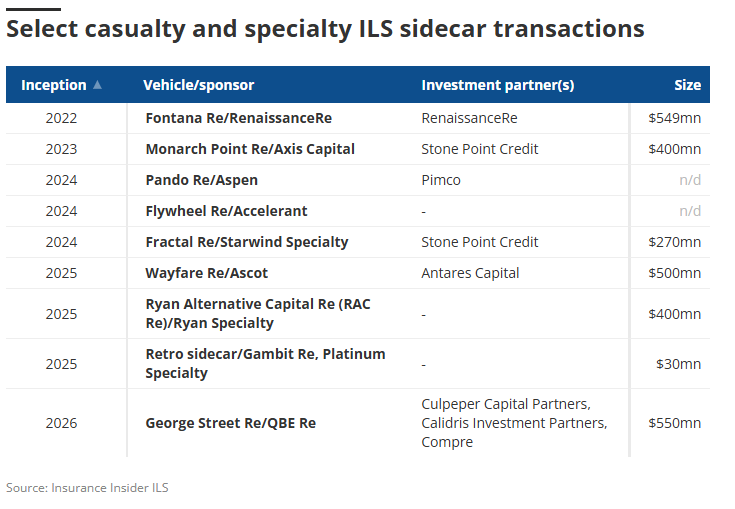
However, many established property cat-focused ILS managers remain cautious about participating in longer-tail transactions.
Speaking at Bermuda’s ILS Convergence event in October, Brian Duperreault, CEO at Cedar Trace, and former AIG CEO, cautioned against the “investment income thinking” that has been a feature of some of the deals.
Nonetheless, broking firms have identified healthy tension between demand from cedants and from capital providers. Private credit capital looks likely to drive segment growth this year.
A report from BlackRock pegged private credit assets under management at $2.1tn as of October 2025 and estimated this will rise to $4.5tn by 2030.
If the ILS industry captured 1% of the growth in private credit projected by BlackRock, that is $24bn by 2030 that would flow into the ILS market.
Aon’s analysis put the sidecar market at $19.6bn, comprising $17.9bn in property sidecars and $1.7bn in casualty vehicles, as of 30 September 2025.
Per Aon’s figures, sidecars currently stand for around 16% of total alternative reinsurance capital of $124bn.
Got a tip for us? Reach out confidentially here.